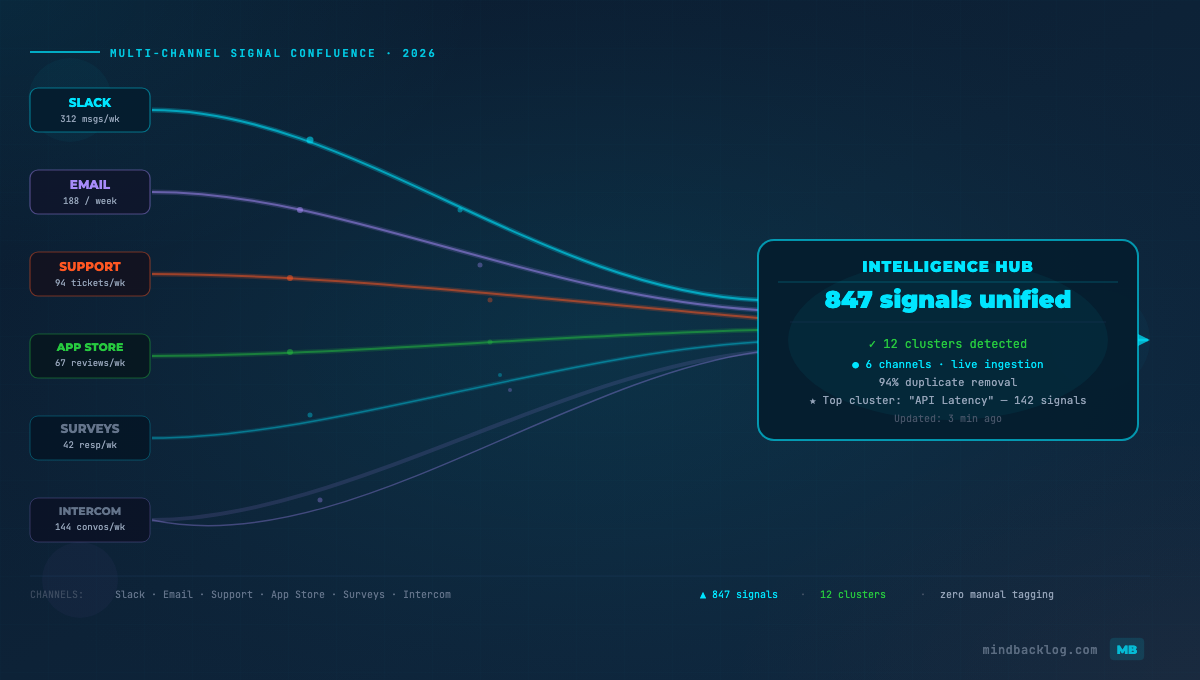
The average B2B SaaS product team receives customer feedback through five to eight different channels — email, support tickets, Slack messages, app store reviews, web forms, portal submissions, and social media mentions. Each channel captures genuine customer insight. None of them talk to each other. The PM is the human integration layer, manually cross-referencing signals across tools, maintaining mental models of which customers said what and where, and hoping they do not miss the crucial signal that arrived through a channel they did not check today.
This fragmentation is not just inefficient — it produces distorted priorities. Features championed by customers who happen to use the channel the PM watches most closely get prioritized. Features requested through channels the PM checks less frequently get overlooked. The PM’s prioritization reflects the distribution of their attention across channels, not the distribution of customer need across the product. Feedback consolidation fixes this by processing every signal from every channel through a single system, producing a unified view where all evidence is weighted equally regardless of source.
What Real Consolidation Requires
Consolidation is more than aggregation. Putting feedback from seven channels into one spreadsheet is aggregation. Consolidation requires six additional capabilities. AI Classification assigns consistent categories (feature request, bug report, complaint, praise) across all channels, regardless of the varying formats and contexts each channel presents. Semantic Deduplication detects when signals from different channels describe the same need using different language — ‘improve search’ from email and ‘user directory is slow’ from app reviews are the same customer need.
Cross-Channel Evidence Linking connects all signals about the same need to a single feature idea, regardless of source. The feature accumulates evidence from every channel. Unified Scoring evaluates features based on the consolidated evidence — total signal count, source diversity, aggregate sentiment, and urgency across all channels. Source Attribution maintains full traceability — the PM can see that a feature has forty-seven supporting signals from five different channels, with the breakdown by source. Pattern Discovery uses the consolidated signal pool to identify emerging needs that would be invisible in any individual channel — the theme that appears only when signals from email, Slack, and app reviews are viewed together.
#1: MindBacklog — Purpose-Built for Consolidation
MindBacklog is architecturally designed for feedback consolidation. Eight native channels (email, Apple/Google Play reviews, web forms, feedback widget, web scraper, public voting portal, Slack) plus unlimited sources via REST API feed into a single 4-phase AI processing pipeline. Every signal from every channel receives identical processing — the same classification, the same deduplication, the same scoring. The PM sees one unified Radar view with signals from every source, consistently processed and consistently scored.
The consolidation depth goes beyond collection. Semantic deduplication catches meaning-level duplicates across channels — an email about ‘slow search’ and a Slack message about ‘user lookup takes forever’ are automatically recognized as describing the same need and linked to the same feature. Nightly HDBSCAN clustering discovers patterns across the consolidated signal pool that would be invisible in any individual channel. Cross-channel evidence linkage means a feature idea accumulates evidence from every source, producing the most comprehensive and defensible evidence base possible.
Source attribution is maintained throughout. Every feature shows its evidence breakdown by channel — how many signals came from email, support, app reviews, Slack, and other sources. Cross-channel evidence (signals from three or more different channels) is a stronger indicator of genuine customer need than single-channel evidence, and MindBacklog makes this distinction visible.
Pricing: $17.99 per seat per month with unlimited signal processing. All eight channels available on every plan.
#2: BuildBetter — Conversation Consolidation
BuildBetter consolidates conversational feedback — customer calls, support tickets, Slack threads, CRM notes, and survey responses — into a unified AI-processed view. Its strength is turning unstructured conversation data into structured insights. For teams where the primary feedback challenge is processing hours of customer call recordings, BuildBetter’s conversation-first architecture is well-suited.
The limitation for broader consolidation is narrower channel coverage — app store reviews, web scraping, and feedback widgets are not primary ingestion channels. Teams with diverse non-conversational feedback sources may find the consolidation incomplete. Enterprise pricing.
#3: Productboard — Moderate Consolidation
Productboard consolidates feedback from its insights portal, Chrome extension, email forwarding, and integrations with Intercom and Zendesk. The consolidation is functional but narrower than purpose-built intelligence platforms — app store reviews, Slack monitoring, web scraping, and REST API ingestion are not core capabilities. AI processing assists but does not drive the consolidation pipeline. Pricing: $25-$80 per maker per month.
#4-5: Enterpret and Dovetail
Enterpret provides strong consolidation across surveys, support tickets, and reviews with its adaptive taxonomy system. The focus is consistent categorization across sources rather than real-time pipeline processing. Enterprise pricing limits accessibility. Dovetail consolidates qualitative research data — interviews, surveys, and observations — into a searchable repository with theme detection. It is research-focused rather than operational-feedback-focused. Pricing: $29-$79 per seat.
Why Cross-Channel Evidence Is More Defensible
A feature supported by twelve signals from one channel (twelve portal votes) has weaker evidence than a feature supported by twelve signals from five channels (four emails, three portal votes, two Slack messages, two app reviews, one web form). The signal count is identical. The evidence strength is dramatically different.
Single-channel evidence reflects the preferences of customers who use that specific channel. It may be biased by the channel’s demographics, the channel’s prominence in your product, or the channel’s ease of use. Cross-channel evidence represents a broader customer base — when customers across five independent feedback mechanisms describe the same need, the need is validated from multiple angles.
This is why consolidation matters for prioritization, not just for data management. Without consolidation, the PM sees channel-specific evidence that may be biased. With consolidation, the PM sees cross-channel evidence that is representative. The feature ranking that emerges from cross-channel evidence is more likely to reflect actual customer need — and more likely to produce product decisions that drive real outcomes.
Getting Started With Consolidation
Start by connecting your three highest-volume feedback channels. For most B2B SaaS teams, this is email (detailed customer requests), the feedback widget (in-context submissions), and Slack (internal team insights). These three channels capture the majority of feedback and can be connected in under thirty minutes. As the consolidated view proves its value — the PM immediately sees patterns they were missing — add remaining channels: app store reviews, web forms, public portal, and web scraper for competitive monitoring.
The investment compounds. Every channel added improves the evidence base. Every signal processed deepens the AI’s understanding. Every week of consolidated data makes the priority scores more accurate and the feature proposals more relevant. Consolidation is not a one-time setup — it is the beginning of a compounding intelligence system.
|
MindBacklog: consolidate feedback from 8 channels + unlimited API sources into one AI-processed intelligence view. Unified classification, cross-channel evidence, and evidence-based scoring. $17.99/seat. Start at mindbacklog.com. |
Ready to put your product intelligence on autopilot? Start your 14-day free trial at MindBacklog.com — no credit card required.


