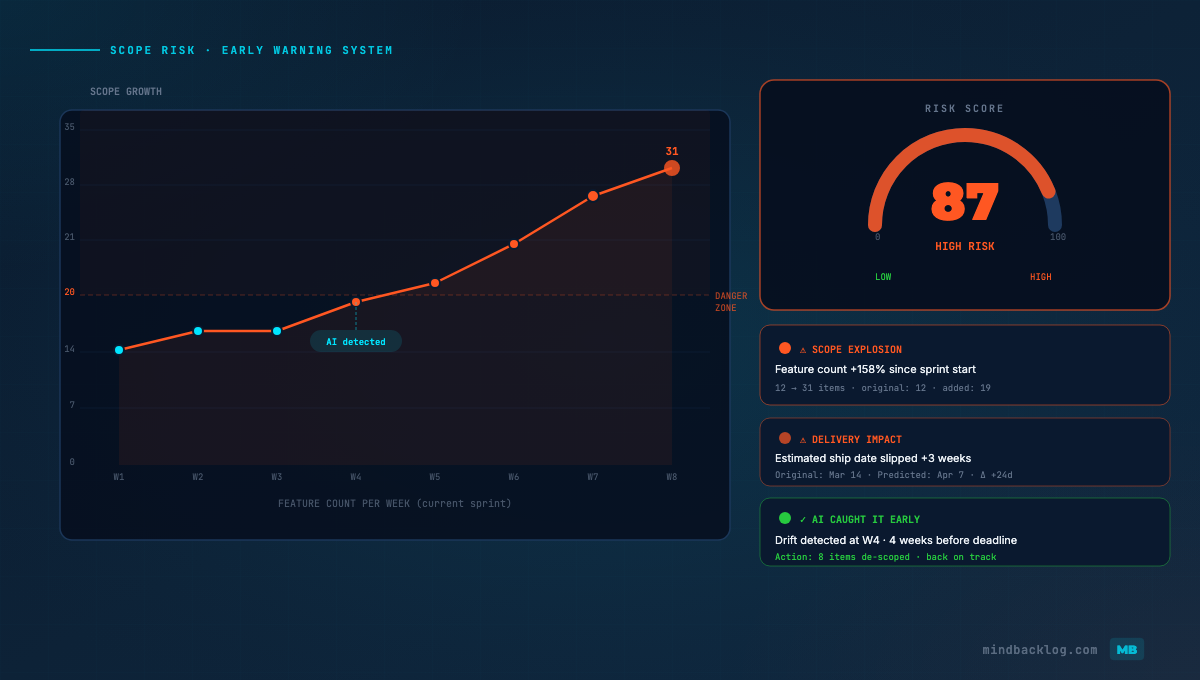
Scope creep is the most predictable failure mode in product development, and yet it surprises teams every quarter. The pattern is always the same: a feature is estimated at four weeks, development begins, new requirements are discovered, edge cases multiply, the integration is more complex than expected, and six weeks later the team is still working on a feature that was supposed to ship two weeks ago. The stakeholder meeting goes from ‘when will this ship?’ to ‘why is this late?’ to ‘what can we cut?’
The most frustrating aspect of scope creep is that it is almost always visible in the data before it becomes visible in the missed deadline. Velocity trends, estimation accuracy patterns, and scope change rates all provide early warning signals — but only if someone is watching for them. AI-powered scope creep detection automates this monitoring, giving PMs early warning when a feature is trending toward delay so they can intervene before the deadline is missed.
Why Scope Creep Is So Hard to See in Real Time
Scope creep is difficult to detect because it happens gradually. No single change is alarming. An additional edge case here, a refinement there, a new acceptance criterion discovered during development. Each addition seems small and reasonable. But the cumulative effect of twenty small additions is a feature that is 40 percent larger than the original estimate, and by the time anyone notices the aggregate growth, the deadline is already in jeopardy.
Teams also suffer from optimism bias during development. When asked ‘are we on track?’ mid-sprint, the typical answer is ‘yes’ — not because the developer is dishonest, but because they are anchored to the original estimate and believe they can make up lost ground. This optimism persists until the final days before the deadline, when the reality of remaining work becomes undeniable. By then, intervention options are limited.
Manual monitoring catches scope creep only when the PM is actively comparing the current state against the original plan — reviewing the number of stories, the total story points, the remaining work, and the team’s velocity trend. Most PMs do this periodically but not continuously, which means the detection is delayed by days or weeks.
How AI Detects Scope Creep Early
AI-powered scope detection works by continuously comparing three data streams: the original estimation (total planned effort), the actual progress (work completed to date at the team’s measured velocity), and the remaining scope (outstanding stories and their estimates, including any that were added after the initial plan).
When these three streams diverge — remaining scope is growing, velocity is lower than expected, or new stories have been added — the system calculates a predicted completion date and compares it against the planned deadline. If the predicted date exceeds the planned date by more than a configurable threshold, the system flags the feature as at risk.
The flags are graduated, not binary. A feature that is trending one day behind schedule gets a yellow indicator — worth monitoring but not alarming. A feature that is trending two weeks behind schedule gets a red indicator — immediate intervention needed. This gradient gives the PM proportional information rather than a simple pass/fail that is either too sensitive (false alarms) or too insensitive (alarms too late).
The Solid Bar / Dotted Bar Pattern
The visual representation of scope creep on a Gantt chart is one of the most immediately useful innovations in modern roadmap tooling. The feature’s original planned timeline is displayed as a solid bar — this represents the commitment that was made to stakeholders. The AI-predicted actual completion timeline is displayed as a dotted bar extending from the end of the solid bar.
When the dotted bar is invisible (the prediction matches the plan), the feature is on track. When the dotted bar extends slightly beyond the solid bar, the feature is at moderate risk. When the dotted bar extends significantly — say, the original plan was four weeks but the predicted completion is seven weeks — the feature has a serious scope creep problem that requires immediate attention.
This visualization is powerful because it communicates scope risk at a glance, without requiring the PM to dig into story-level data. In a roadmap review meeting, the PM can scan the timeline and immediately identify which features need discussion — they are the ones with visible dotted extensions. Features without extensions are on track and can be skipped.
Intervention Strategies When Scope Creep Is Detected
Early detection is only valuable if it enables effective intervention. When AI flags a feature as at risk, the PM has several options depending on the severity and the feature’s strategic importance.
Scope reduction is the most common intervention: review the outstanding stories and remove or defer those that are not essential for the initial release. This requires clear communication about what is being deferred and why, but it is usually the fastest path to getting the feature back on track.
Re-estimation is appropriate when the original estimate was fundamentally wrong rather than when scope has expanded. If the team now has a better understanding of the complexity, a revised estimate based on actual velocity is more honest than trying to force the original timeline.
Resource adjustment — adding capacity to the feature — is sometimes appropriate but should be used cautiously. Adding people to a late project often makes it later (as Brooks’s Law famously observes). It works best when the remaining work is parallelizable and the added people are already familiar with the codebase.
Stakeholder reset is the intervention of last resort: communicating to stakeholders that the feature will ship later than planned, with a revised date based on actual data rather than optimistic hope. Early detection makes this conversation much easier — ‘we identified the risk three weeks ago and adjusted our plan’ is a very different message than ‘we just realized this will be late.’
|
MindBacklog’s Timeline View detects scope creep before it becomes a crisis. Solid bars show your plan. Dotted bars show the AI prediction. The gap between them tells you where to focus. Start at mindbacklog.com. |
Ready to put your product intelligence on autopilot? Start your 14-day free trial at MindBacklog.com — no credit card required.


