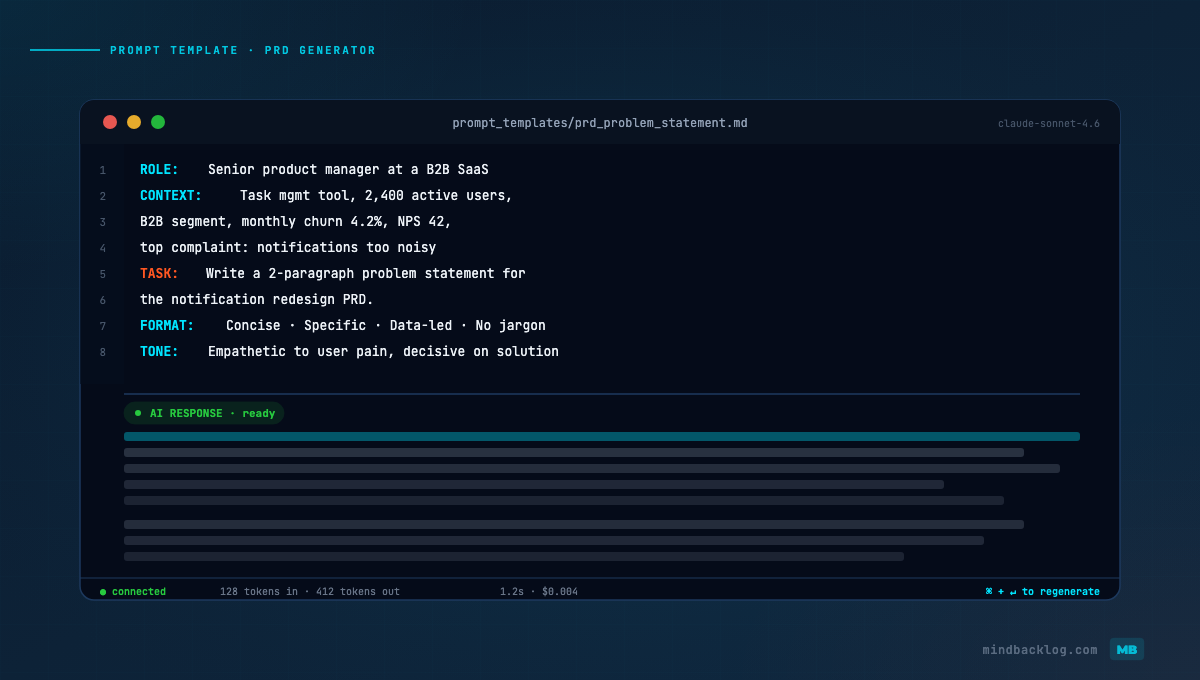
Every product manager now uses AI in some form — whether it is ChatGPT for drafting, Claude for analysis, or a dedicated PM tool with built-in AI features. But the quality of AI output varies enormously based on how you ask. A vague prompt produces a vague response. A structured prompt with context, constraints, and clear expectations produces output that is immediately useful.
Prompt engineering is the skill of crafting effective queries to get the most value from AI systems. For PMs, this means learning the prompt patterns that work best for PM-specific tasks: feature analysis, competitive research, specification writing, stakeholder communication, and strategic synthesis. This guide provides twenty ready-to-use templates and explains the principles behind them so you can create your own.
The Anatomy of an Effective PM Prompt
Every effective PM prompt contains four elements. Context tells the AI what it needs to know about your product, your users, and the specific situation. Without context, the AI guesses — and guesses produce generic output. Instruction tells the AI what task to perform. Be specific: ‘Write acceptance criteria’ is better than ‘help me with this feature.’ Constraints set boundaries: the format you want, the length, what to include and exclude, and who the audience is. Output specification describes the exact deliverable: ‘Provide a bulleted list of 5-7 acceptance criteria in Given/When/Then format’ is dramatically better than ‘write some acceptance criteria.’
The most common prompt mistake PMs make is omitting context. When you ask AI to ‘write a PRD for improving search,’ you get a generic document about search improvements. When you provide context — ‘Our product is a B2B customer success platform. The user directory is used by CSMs managing 50+ accounts. Customers have reported that finding specific users takes too long when managing large account lists. Our main competitor just launched advanced search filtering.’ — you get a PRD that is specific, relevant, and immediately useful.
Feature Analysis Prompts
Template 1 — Feature Impact Assessment: ‘Given the following feature description: [paste description]. Our product serves [target users] in [industry]. Our current strategic objectives are [list objectives]. Analyze this feature across five dimensions: revenue impact, retention impact, competitive positioning, implementation complexity, and strategic alignment. For each dimension, provide a score (1-5) with a one-sentence justification.’
Template 2 — Signal Synthesis: ‘I have [number] pieces of customer feedback about [topic]. Here are representative examples: [paste 5-7 examples]. Synthesize these into a clear problem statement that captures the common theme, identifies the affected user segment, and quantifies the frequency and severity of the issue.’
Template 3 — Competitive Feature Comparison: ‘Compare how our product and [competitor name] handle [feature area]. Our implementation: [describe]. Their implementation (based on public information): [describe]. Identify our advantages, their advantages, and the most impactful improvement we could make to close the gap.’
Template 4 — Opportunity Sizing: ‘We are considering building [feature]. Our current user base is [size] with [breakdown by segment]. Based on the following customer feedback signals: [paste signals]. Estimate the potential reach (what percentage of users would benefit), the likely adoption rate, and the expected impact on [key metric].’
Specification Writing Prompts
Template 5 — PRD Generation: ‘Write a Product Requirements Document for the following feature: [title and description]. Product context: [2-3 sentences about the product]. Target users: [user segment]. Customer evidence: [paste key signals]. Strategic objective this supports: [objective]. Include: problem statement, target users, proposed solution, functional requirements (must-have and nice-to-have), non-functional requirements, success metrics, and open questions.’
Template 6 — User Story Creation: ‘Based on the following feature description: [paste]. Write [number] user stories using the format: As a [specific persona], I want [specific capability], so that [measurable outcome]. For each story, include 3-5 acceptance criteria in Given/When/Then format and any non-functional requirements (performance, accessibility, security).’
Template 7 — Acceptance Criteria Expansion: ‘Here is a user story: [paste story]. Expand the acceptance criteria to cover: the primary happy path, the most likely error state, edge cases for [specific scenario], and any performance or accessibility requirements. Use Given/When/Then format.’
Template 8 — Technical Specification: ‘Based on the following PRD: [paste or summarize]. Write a technical specification that covers: proposed architecture approach, API contract changes, database schema changes, integration points, performance requirements, and migration considerations. Our tech stack is [describe stack].’
Stakeholder Communication Prompts
Template 9 — Executive Roadmap Summary: ‘Summarize the following roadmap for an executive audience: [paste feature list with statuses]. Organize by strategic theme rather than feature name. For each theme, state the business outcome we are targeting, the key features contributing to it, and the expected timeline. Keep the tone confident and outcome-focused. Maximum 1 page.’
Template 10 — Priority Decision Rationale: ‘I need to explain to stakeholders why [Feature A] is prioritized above [Feature B]. Here is the evidence: Feature A: [signal count, customer value, strategic alignment]. Feature B: [same data]. Write a clear, concise explanation that acknowledges both features’ value while explaining the data-driven reasoning for the prioritization. Tone: empathetic but firm.’
Template 11 — Sprint Review Summary: ‘Based on the following sprint data: [paste completed stories, velocity, carryover items]. Write a sprint review summary for the product team that covers: what we shipped, what carried over and why, velocity trend, and key risks for next sprint.’
Template 12 — Customer Update Draft: ‘A customer asked about [feature/request]. Current status: [describe]. Write a brief, professional email that acknowledges their request, provides the current status, and sets appropriate expectations. Do not commit to specific dates.’
Strategic Analysis Prompts
Template 13 — Market Trend Analysis: ‘Based on the following competitive signals: [paste recent competitor moves, market news]. Identify the top 3 trends that should influence our product strategy. For each trend, explain what is happening, why it matters for our product, and what action we should consider.’
Template 14 — Quarterly Planning Prep: ‘Our product serves [description]. Current strategic objectives: [list]. Key metrics from last quarter: [paste]. Top customer feedback themes: [list top 5]. Recommend 3-5 strategic themes for next quarter, each with: the outcome we should target, the customer evidence supporting it, and 2-3 candidate features.’
Templates 15-20 cover additional scenarios: release notes drafting, interview guide creation, churn analysis synthesis, onboarding friction analysis, retrospective insights, and go-to-market planning — each following the same four-element structure of context, instruction, constraints, and output specification.
Why Platform-Level AI Makes Prompt Engineering Optional
These templates are powerful, but they highlight a fundamental limitation of general-purpose AI tools: the PM must provide the context manually in every prompt. Product description, customer feedback, competitive data, strategic objectives — all must be pasted in, every time, for every query.
AI-native product management platforms eliminate this requirement by maintaining persistent product context that is automatically injected into every AI interaction. When you click ‘Generate PRD’ in a context-aware platform, the system already knows your product, your users, the feature’s linked signals, and your strategic objectives. No prompt engineering needed — the context is built into the system.
This is the evolution from prompt engineering (a per-interaction skill) to context engineering (a system-level investment). Prompt engineering is valuable when working with general-purpose AI. Context engineering makes prompt engineering unnecessary by ensuring the AI always has the context it needs.
|
MindBacklog eliminates the need for PM prompt engineering. The MIND engine knows your product context and injects it into every AI interaction automatically. Click ‘generate’ and get specific, evidence-grounded outputs. No prompt crafting required. Start at mindbacklog.com. |
Ready to put your product intelligence on autopilot? Start your 14-day free trial at MindBacklog.com — no credit card required.


