Open Jira, and you will find a product board with eight to twelve status columns, hundreds of tickets in various states of stale, and a PM who needs thirty minutes just to remember what everything means. Open Productboard, and you will find a sophisticated but complex workspace with multiple views, custom fields, and a learning curve measured in weeks. Open most enterprise PM tools, and you will find a system that creates more organizational overhead than it eliminates.
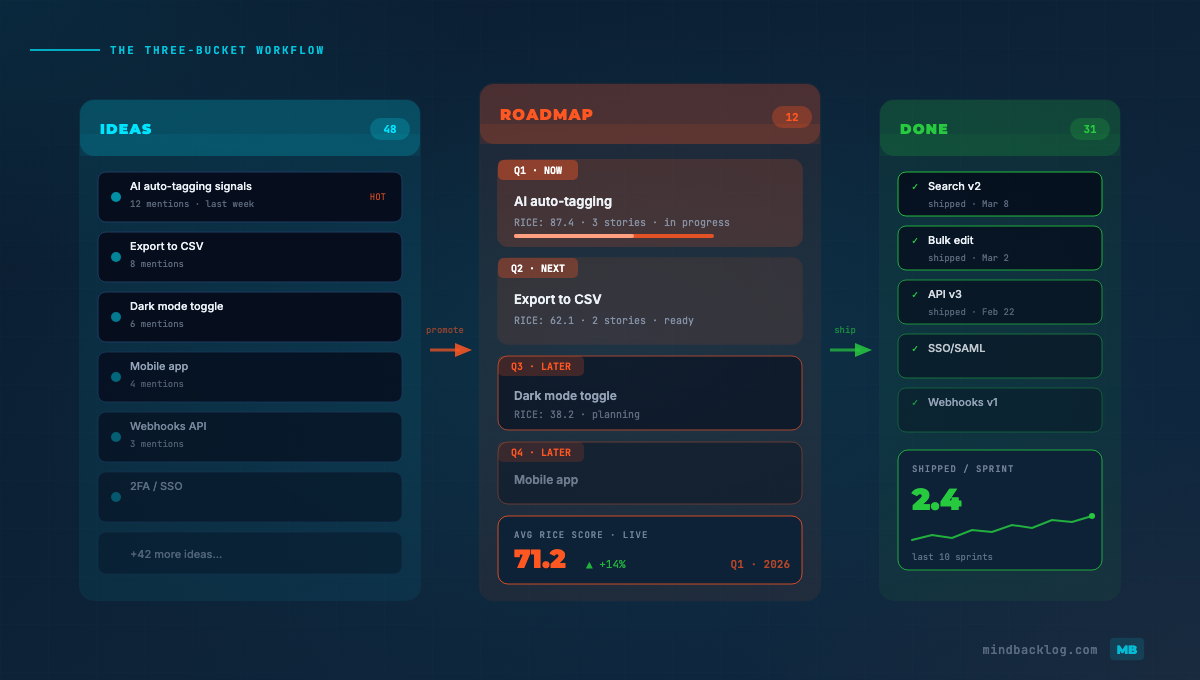
The three-bucket workflow is a deliberate reaction to this complexity. It reduces the entire product management pipeline to three stages — Radar, Ideas, and Roadmap — each with a clear purpose, a defined set of actions, and a natural flow from left to right. The constraint is intentional. By limiting the system to three stages, it becomes impossible to create the sprawling, multi-column boards that characterize most PM tools and that consume PM attention without advancing product decisions.
Bucket 1: Radar — Where Signals Land
Radar is the signal command center. It is where all customer feedback lands after passing through the AI processing pipeline. The PM does not need to monitor email, check Reddit, browse app store reviews, or triage support tickets. All of that is handled by the automated pipeline. By the time the PM opens Radar in the morning, every signal from the previous day has been ingested, classified, scored, and — where possible — linked to an existing feature idea.
The PM’s role in Radar is review and triage, not data entry and classification. They scan the classified signals, verify that the AI’s categorization is correct (correcting the occasional misroute), and decide which signals warrant promoting to an existing feature idea or creating a new one. For most teams, this review takes fifteen to thirty minutes per day — a fraction of the hours that manual triage consumes.
The critical design principle of Radar is that it should require minimal cognitive effort. The hard work — ingestion, classification, deduplication, and linking — is automated. The PM’s energy is preserved for the Ideas stage, where the real intellectual work of product management happens.
Bucket 2: Ideas — Where Features Mature
Ideas is the feature refinement workspace. This is where features are scored, validated, and prepared for the roadmap. It is the only stage in the three-bucket workflow that demands active, sustained PM attention — and that is by design.
Features arrive in Ideas from three sources: manual creation by the PM, promotion from Radar signals, or proposals from the nightly clustering job (where the AI groups unmatched signals into new feature candidates). Each feature enters in ‘Drafting’ status and progresses through ‘Validating’ (being researched and evaluated), ‘Roadmap Ready’ (validated and approved for scheduling), or ‘Icebox’ (deliberately shelved for future reconsideration).
The PM’s work in Ideas includes enriching features with descriptions and context, reviewing and linking supporting signals, evaluating AI-generated priority scores, generating PRDs and user stories, and making the strategic judgment calls that determine which features advance to the roadmap and which are shelved. This is the cognitive heart of product management — the place where evidence meets judgment, where data meets strategy, and where the PM adds value that no AI can replicate.
Both list and kanban views are available, with multi-filter capabilities by status, owner, product area, T-shirt size, and tags. A summary strip provides aggregate counts and pipeline health at a glance. Drag-and-drop reordering is persisted across sessions for manual priority adjustments.
Bucket 3: Roadmap — Where Work Gets Scheduled
Roadmap is where validated features are scheduled for execution. Features that reach ‘Roadmap Ready’ in the Ideas stage are promoted to the Roadmap, where they receive start and end dates, team assignments, and dependency relationships.
The PM’s role in the Roadmap stage is primarily passive monitoring rather than active management. Once features are scheduled, the Roadmap tracks status (Planned, In Development, Shipped) and surfaces issues that need attention: scheduling conflicts, dependency blockers, and features that are trending behind plan. The PM intervenes when something requires a decision — rescheduling, re-scoping, or reassigning — but does not need to actively maintain the view.
The Timeline view provides a Gantt chart with dependency visualization, team workload distribution, and (when development data is available) predictive timeline overlays showing where actual progress diverges from the plan. This is the view that is purpose-built for stakeholder presentations — every feature on the timeline can be clicked to show the customer signals that justify its position.
Why Three Buckets, Not Eight Columns
The three-bucket architecture is intentionally constrained. Most PM tools offer extensive customization — custom status columns, custom fields, custom workflows — on the assumption that more options are better. In practice, extensive customization creates maintenance overhead. Someone has to define the columns, decide what each one means, train the team on when to use each one, and enforce consistency. The columns multiply, the meaning blurs, and the board becomes a reflection of the organization’s process complexity rather than a simplification of it.
Three buckets eliminate this overhead. There is no ambiguity about what each stage means. Radar is for signals. Ideas is for features. Roadmap is for scheduled work. The transition between stages is clear: signals promote to features, features promote to roadmap items. The PM does not spend time deciding which of twelve columns a ticket belongs in. They make one decision: is this signal a feature idea, and is this feature idea ready for the roadmap?
The effort distribution reflects this simplicity. Radar demands about 10 percent of PM effort because it is 90 percent automated. Roadmap demands about 20 percent because it is primarily passive monitoring. Ideas demands about 70 percent — and that is exactly right, because Ideas is where the PM adds the most value. The three-bucket architecture channels PM energy to where it matters most.
The Signals-Features Distinction
A critical conceptual distinction that the three-bucket workflow enforces is the separation between signals and features. Signals are individual pieces of customer feedback — an email, a review, a support ticket, a form submission. They live in Radar and in the Raw Feed. Features are product-level ideas that represent a potential buildable unit. They live in Ideas and Roadmap.
Multiple signals link to a single feature. A feature might have evidence from thirty signals across five channels, all describing different aspects of the same customer need. This many-to-one relationship is the foundation of evidence-based prioritization: the more signals linked to a feature, the stronger the evidence that the feature addresses a genuine, widespread customer need.
The three-bucket workflow makes this relationship explicit. Signals flow through Radar. Features are managed in Ideas and Roadmap. The connection between them — the evidence trail from raw customer voice to prioritized product decision — is maintained throughout the lifecycle.
|
MindBacklog’s three-bucket workflow — Radar, Ideas, Roadmap — replaces complex multi-column boards with a simple, AI-powered pipeline. Signals land automatically. Features mature with AI assistance. Roadmaps are backed by evidence. Simplify your workflow. Start at mindbacklog.com. |
Ready to put your product intelligence on autopilot? Start your 14-day free trial at MindBacklog.com — no credit card required.