The Product Requirements Document has been declared dead more times than any other artifact in product management. ‘Nobody reads PRDs.’ ‘They are always outdated by the time development starts.’ ‘Just talk to the engineers directly.’ These critiques contain real observations about how PRDs have traditionally been written — as static, comprehensive documents that take days to produce and decay within weeks. But the solution is not to abandon requirements documentation. It is to fundamentally change how PRDs are created, maintained, and used.
In 2026, the PRD is evolving from a static Word document into a dynamic, AI-generated, evidence-grounded specification that stays synchronized with the product’s evolving understanding of the feature. The modern PRD is not written from scratch by the PM. It is generated from the product’s context and customer evidence, refined by the PM’s strategic judgment, and regenerated as new information arrives. This changes the economics of PRD creation — from an investment of days to an investment of minutes — and makes it practical to maintain specifications that are always current.
When You Need a PRD (and When You Do Not)
Not every feature needs a full PRD. Applying comprehensive documentation to simple features wastes time without reducing risk. The decision of when to write a PRD should be based on the feature’s complexity, risk, and stakeholder landscape.
Write a full PRD for features that span multiple product areas, involve architectural changes, affect critical user workflows, have multiple stakeholders with potentially conflicting requirements, or represent significant investment of engineering time. These features carry enough complexity and risk that the upfront investment in a comprehensive specification pays for itself in reduced ambiguity, fewer mid-development discoveries, and smoother stakeholder alignment.
Use a lean specification (one-page brief or detailed user stories with acceptance criteria) for features that are well-understood, limited in scope, owned by a single team, and have clear acceptance criteria. The engineering team does not need a ten-page document for a straightforward improvement that everyone understands.
The Eight Sections of a Modern PRD
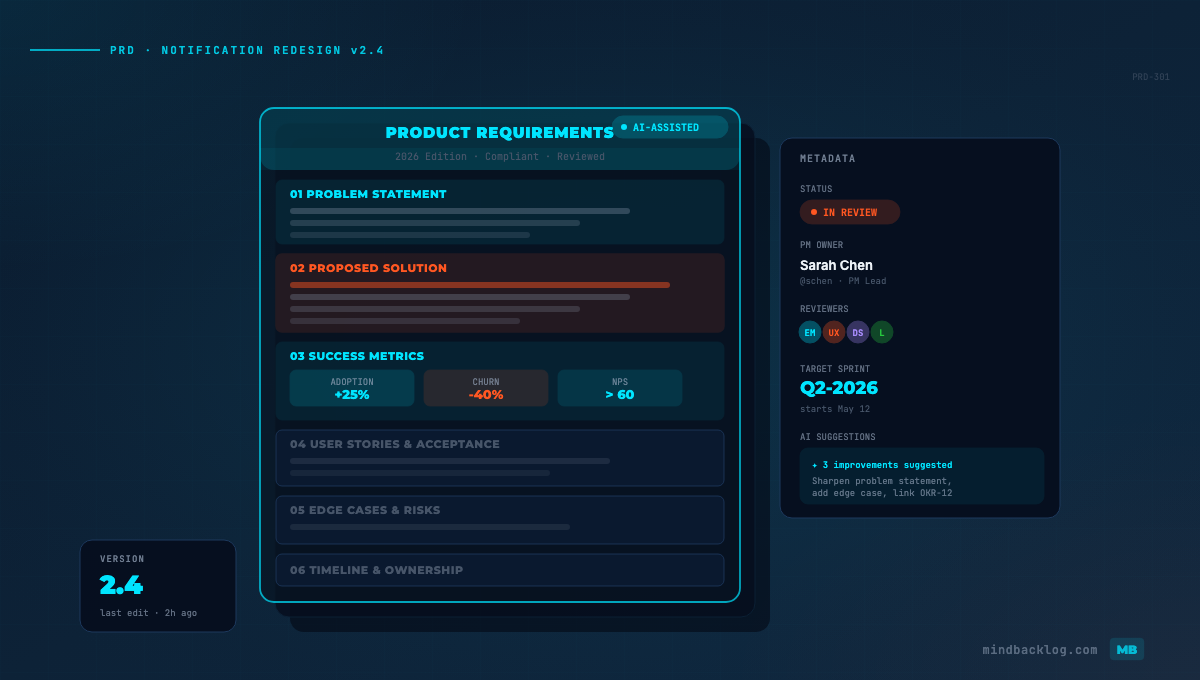
A modern PRD contains eight sections, each serving a specific purpose and each informed by different types of context. Problem Statement defines why this feature exists — the customer pain points, the business impact of the problem, and the opportunity cost of inaction. This section should be grounded in customer evidence: signal counts, representative quotes, and sentiment data. AI excels at synthesizing this section from linked signals.
Target Users defines who this feature serves — specific user personas, their workflows, and their use cases. This section should reference your product’s defined user segments rather than generic descriptions. A context-aware AI draws this from your product’s Master Profile.
Proposed Solution describes what the feature will do at a conceptual level — the approach, the scope, and the key design decisions. This section requires the most PM input, as it reflects strategic choices that the AI cannot make independently.
Functional Requirements detail the specific capabilities the feature must include, organized by priority (must-have, should-have, nice-to-have). AI generates initial requirements from the feature description and linked signals, and the PM refines the prioritization and adds domain-specific nuances.
Non-Functional Requirements cover performance targets, accessibility standards, security requirements, and scalability considerations. AI can generate standard NFRs based on your product’s technical context and the feature’s characteristics.
Success Metrics define how you will measure whether the feature achieves its intended outcome. These should be tied to your strategic objectives — if the feature supports a retention objective, the success metric should be a retention indicator. AI can suggest metrics based on objective alignment.
Technical Considerations flag architectural implications, integration dependencies, data migration needs, and technical risks. This section benefits from engineering input and is where the PM should collaborate with the tech lead before finalizing.
Open Questions explicitly list what is not yet known — design decisions that need user testing, technical questions that need spike investigation, business questions that need stakeholder input. This section is often omitted from traditional PRDs but is one of the most valuable, because it prevents assumptions from being treated as decisions.
The AI-Assisted PRD Workflow
The most effective workflow for modern PRD creation follows five steps. First, enrich the feature. Before generating a PRD, ensure the feature has a descriptive title, a meaningful description, linked customer signals, a defined product area, and (ideally) a connection to a strategic objective. The richer the feature’s context, the more specific the generated PRD.
Second, generate the AI draft. The system produces a complete PRD using the feature’s context, linked signals, product knowledge, and strategic objectives. This draft takes minutes to generate and provides a solid foundation for every section.
Third, refine the PM’s sections. Focus refinement on the Proposed Solution (which requires strategic judgment), the Functional Requirements prioritization (which reflects scope decisions), and the Open Questions (which only the PM can identify based on their knowledge of the project’s uncertainties).
Fourth, collaborate with engineering. Share the draft PRD and iterate on the Technical Considerations and NFR sections. Engineering input at this stage prevents specifications that are technically impractical or that miss important implementation constraints.
Fifth, keep it alive. As new signals arrive, as competitive dynamics shift, or as engineering discoveries change the technical landscape, regenerate the PRD to reflect current reality. Review the diff, approve the changes, and maintain a specification that is always current.
|
MindBacklog generates full PRDs from your product context and customer evidence — not templates. Problem statements cite real signals. Requirements reference your architecture. Success metrics tie to your objectives. Write better PRDs in 10% of the time. Start at mindbacklog.com. |
Ready to put your product intelligence on autopilot? Start your 14-day free trial at MindBacklog.com — no credit card required.


