A product team’s feedback system is only as good as the signals flowing into it. The most sophisticated AI processing pipeline in the world produces nothing useful if the pipeline is empty. And for most product teams, the pipeline is far emptier than it should be — not because customers are not talking, but because the organization has not built the culture and infrastructure to capture what they say.
Building a feedback-driven culture means creating an environment where every team member — sales, support, engineering, marketing, and leadership — regularly contributes customer insights into the product intelligence system. It means making feedback submission easy, making the impact of feedback visible, and closing the loop so contributors see that their input leads to product action. This is a cultural challenge, not a technical one, but the right tools make the culture dramatically easier to build.
Why Most Teams Underperform on Feedback Collection
The typical product team has one primary feedback collector: the PM. Everyone else — sales reps who hear feature requests on every call, support agents who see the same complaint twenty times a week, engineers who notice usability issues during development — has customer insight but no clear mechanism or incentive to share it with the product team.
The barriers are almost never technological. They are cultural and procedural. Sales reps do not submit feedback because they do not know where to submit it, the submission process is too cumbersome, or they have never seen their past feedback result in product action. Support agents do not flag product themes because their performance is measured on ticket resolution speed, not product intelligence. Engineers do not report usability observations because there is no forum for technical product feedback that does not feel like filing a complaint.
The result is a massive intelligence gap. The PM’s view of customer needs is based on the feedback that happens to reach them — which is a small and biased sample of the total intelligence available within the organization.
Making Submission Frictionless
The single most effective intervention for improving feedback flow is reducing submission friction. Every additional step in the submission process reduces the number of people who will use it. The ideal submission takes less than thirty seconds and requires no context-switching from the contributor’s normal workflow.
For sales teams, this might be a Slack command that captures a feature request with the customer’s name and context: ‘/feedback Acme Corp needs SSO for their security review.’ For support teams, this might be a one-click tag on a support ticket that flags it as containing product feedback. For engineering, this might be a lightweight internal form accessible from the development environment. For executives, this might be a dedicated email address where they forward customer conversations.
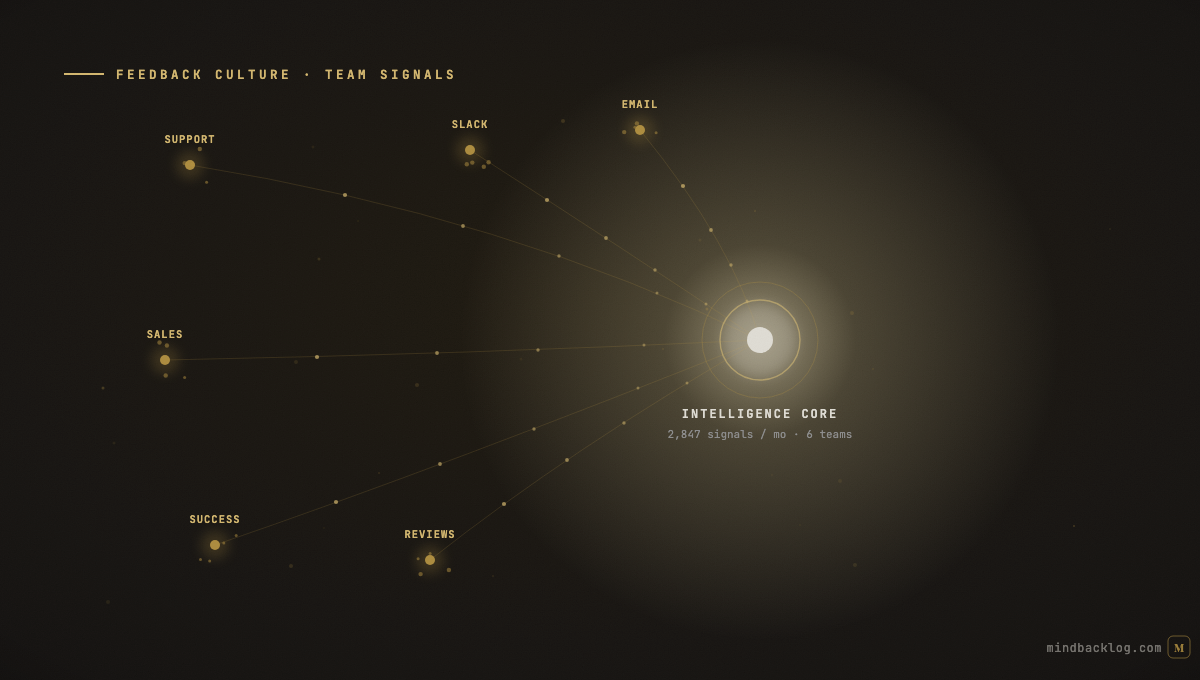
All of these submission channels should feed into the same AI processing pipeline. The sales Slack message, the tagged support ticket, the engineering form, and the executive email all enter the same system, receive the same classification, and contribute to the same priority scores. The contributor does not need to categorize, prioritize, or format their input — the AI handles that. Their only job is to capture the signal.
Showing Impact: The Motivation Engine
The most powerful motivator for consistent feedback contribution is visible impact. When a sales rep submits a feature request and later sees that feature on the roadmap — with their submission cited as evidence — they submit more frequently and with more detail. When a support agent’s flagged ticket contributes to a feature that reduces the ticket volume they were seeing, they flag more tickets.
Build visibility into your feedback process. When a feature ships, communicate which team members’ feedback contributed to the decision. Maintain a dashboard or periodic report showing the journey from feedback to feature: ‘This quarter, 47 feedback submissions from 12 team members directly influenced 8 features on the roadmap.’ Name the contributors. Celebrate the impact.
This visibility creates a virtuous cycle. Contributors see that their effort matters. They contribute more. The product intelligence improves. Product decisions get better. Better products generate more customer engagement. More engagement generates more feedback. The cycle compounds.
Cross-Functional Feedback: What Each Team Contributes
Each function in the organization contributes a different type of product intelligence, and the feedback system should capture all of them.
Sales teams contribute competitive intelligence and deal-blocking requirements. They hear firsthand what prospects compare you against, what features close deals, and what gaps lose them. Their feedback is uniquely valuable for prioritizing features that drive acquisition and expansion.
Support teams contribute pattern data about product friction. Individual tickets are data points. The themes across hundreds of tickets are intelligence. Support feedback is uniquely valuable for identifying must-have improvements and usability issues that affect the broad customer base.
Engineering teams contribute technical feasibility insights and internal quality observations. They notice performance degradation, architectural limitations, and usability issues from a technical perspective that customers may experience but cannot articulate. Engineering feedback is uniquely valuable for technical debt prioritization and quality investment decisions.
Customer success teams contribute retention intelligence. They know which accounts are at risk, which features drive expansion, and which workflows cause the most confusion during onboarding. Their feedback is uniquely valuable for prioritizing retention-critical improvements.
Leadership contributes strategic context. Executive conversations with board members, industry peers, and strategic partners provide market-level insight that is not available through customer channels. This feedback is uniquely valuable for validating or challenging the product’s strategic direction.
Measuring Feedback Culture Health
Three metrics indicate whether your feedback culture is healthy and improving. Contribution breadth measures how many unique team members have submitted feedback in the past month. A healthy culture has contributions from every function, not just the PM and one or two engaged individuals. Submission-to-feature ratio measures what percentage of submitted feedback eventually links to a feature on the roadmap. A healthy ratio (above 40 percent) indicates that contributions are actionable and valued. Contributor retention measures whether people who submit feedback once continue submitting. A healthy culture retains contributors over time rather than losing them after an initial burst of enthusiasm.
Track these metrics monthly and treat them as leading indicators of your product intelligence quality. When contribution breadth narrows, investigate whether a specific function has disengaged and why. When submission-to-feature ratio drops, investigate whether the feedback quality is declining or the processing pipeline is underperforming.
|
MindBacklog captures feedback from every source — email, forms, widgets, and internal submissions — and processes it through the same AI pipeline. Make contribution easy. Show impact automatically. Build the feedback culture your product deserves. Start at mindbacklog.com. |
Ready to put your product intelligence on autopilot? Start your 14-day free trial at MindBacklog.com — no credit card required.