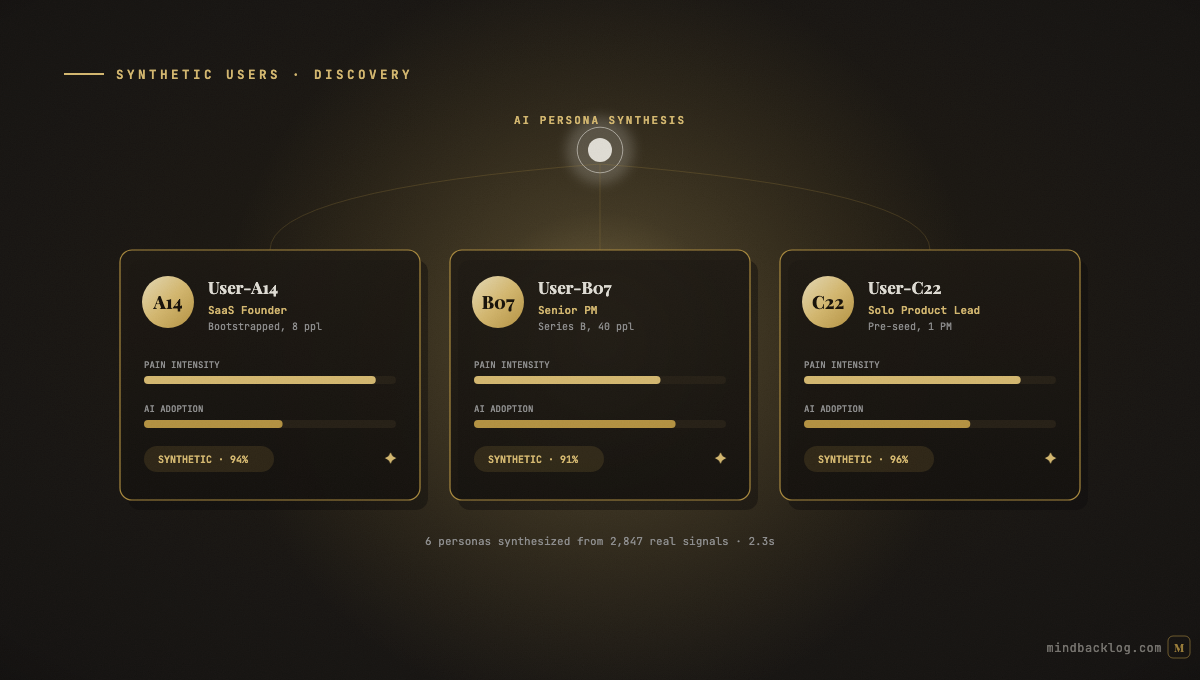
The concept of synthetic users — AI-generated personas that simulate real customer behavior for testing product hypotheses — has moved from academic curiosity to practical tool in 2026. The promise is compelling: instead of spending weeks recruiting, scheduling, and conducting focus groups or user interviews, you describe your hypothesis to an AI system that simulates how different user types would respond. The simulation runs in minutes. The cost is negligible. The scale is unlimited.
The reality is more nuanced. Synthetic users are genuinely useful for specific research tasks, genuinely dangerous for others, and genuinely misunderstood by most teams that encounter them. This article separates the hype from the substance and provides a practical framework for when synthetic users add value to product discovery and when they are no substitute for talking to real humans.
How Synthetic Users Work
Synthetic user generation starts with a data foundation — real customer feedback, behavioral data, and persona characteristics drawn from your existing user base. The AI constructs simulated personas that embody the patterns in this data: a synthetic enterprise CSM who manages fifty accounts, experiences the same pain points that real CSMs have described in feedback, and responds to product concepts based on the preferences and behaviors observed in the real user population.
The key distinction from pure AI roleplay (asking ChatGPT to ‘pretend you are a CSM’) is the data grounding. A synthetic user generated from your actual feedback data inherits the specific pain points, language patterns, and behavioral tendencies of your real users. It does not imagine what a CSM might want — it extrapolates from what your CSMs have actually said. This grounding in real data is what makes synthetic users potentially useful rather than purely fictional.
Once generated, synthetic users can be queried about product concepts, feature proposals, and workflow changes. You describe a feature idea and ask the synthetic user panel how they would respond. The AI simulates responses based on the persona characteristics, generating reactions that approximate how the real user segment might evaluate the proposal.
Where Synthetic Users Add Genuine Value
Synthetic users are most valuable for three research activities. First, rapid hypothesis screening. Before investing in full user research, you can test twenty hypotheses against a synthetic panel in an afternoon to identify the three or four that warrant deeper investigation with real users. This screening function is valuable not because the synthetic responses are definitive, but because they filter out obviously weak hypotheses at near-zero cost.
Second, coverage gap filling. Your real research may cover enterprise users well but lack input from small-business users. Synthetic users generated from the small-business segment of your feedback data can provide approximate input for an underrepresented segment while you work on recruiting real participants.
Third, consistency testing. Running the same research protocol against a synthetic panel ensures that your methodology produces coherent results before you invest real participants’ time. If the synthetic responses reveal that your interview questions are ambiguous or your prototype flow is confusing, you can iterate the research design before conducting sessions with actual users.
Where Synthetic Users Fail
Synthetic users have fundamental limitations that make them inappropriate as a replacement for real user research. The most critical limitation is that they cannot generate novel insight. Synthetic users extrapolate from existing data — they can tell you how users who match known patterns would respond, but they cannot surface needs, behaviors, or emotional responses that are not already represented in your data. The unexpected insight, the surprising reaction, the ‘I never thought about it that way’ moment — these are the most valuable outputs of real user research, and synthetic users cannot produce them.
Synthetic users also cannot capture emotional nuance. A real user’s hesitation before answering, their body language when encountering a confusing interface, their tone when describing a workaround they have built — these non-verbal signals carry enormous information that AI cannot simulate. The difference between ‘this is fine’ said with genuine satisfaction and ‘this is fine’ said with resigned acceptance is invisible to a synthetic user but obvious in a real conversation.
Finally, synthetic users inherit the biases in your data. If your feedback data over-represents power users and under-represents casual users, your synthetic personas will do the same. The AI cannot correct for sampling bias — it can only reflect the patterns in the data it was given. This means synthetic user research can reinforce existing blind spots rather than revealing them.
The Hybrid Approach: Synthetic Screening, Real Validation
The most effective use of synthetic users is as a complement to real research, not a replacement for it. Use synthetic users to screen hypotheses, generate initial reactions, and identify the most promising directions. Then validate the most important findings with real users through interviews, usability tests, and prototype testing.
This hybrid approach captures the cost and speed advantages of synthetic research while preserving the depth and validity of real human interaction. It is not an either-or choice. It is a layered research strategy where synthetic and real research serve different functions in the discovery process.
The teams that will use synthetic users most effectively are those that already have strong real-user research practices. Synthetic users amplify good research — they do not replace it. A team that relies exclusively on synthetic research will develop an increasingly distorted view of their customers, because the synthetic models will drift further from reality without the calibration that real conversations provide.
|
MindBacklog’s MIND engine builds rich user understanding from real customer feedback across every channel. This data foundation is what makes AI-driven analysis genuinely useful — grounded in real signals, not synthetic guesses. Start at mindbacklog.com. |
Ready to put your product intelligence on autopilot? Start your 14-day free trial at MindBacklog.com — no credit card required.


