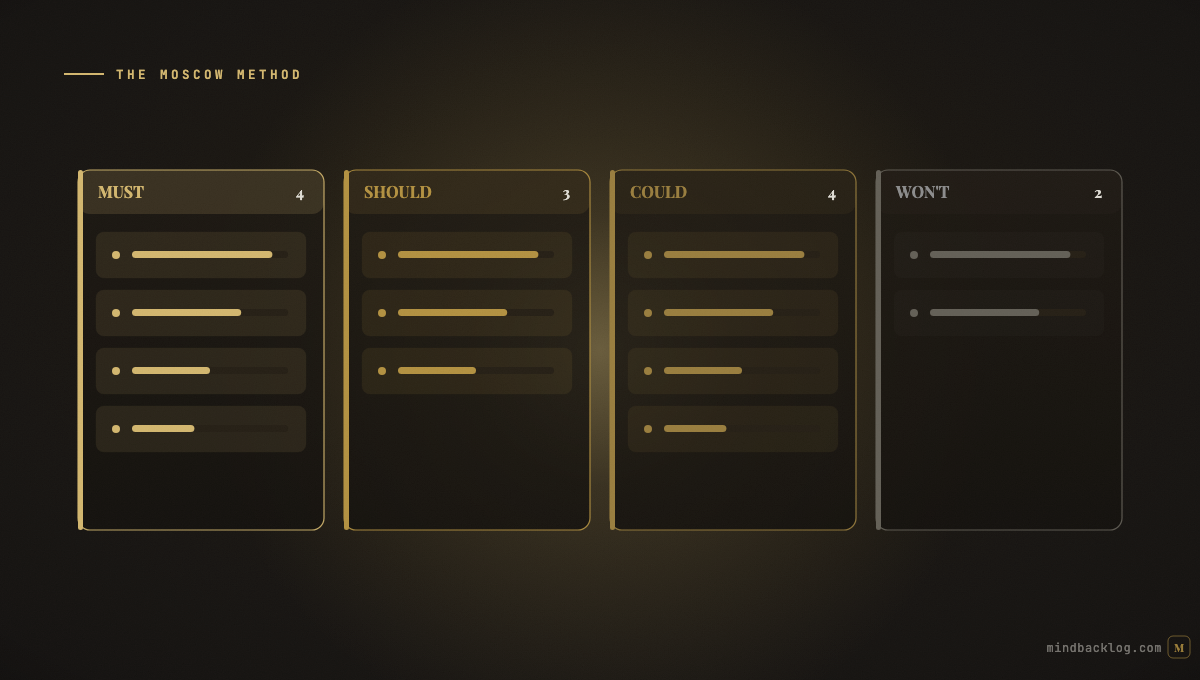
MoSCoW — Must-have, Should-have, Could-have, Won’t-have — is one of the simplest and most widely used prioritization frameworks in product development. Originating from the Dynamic Systems Development Method (DSDM), it categorizes features into four buckets based on their necessity for a given release or planning period. Its simplicity is its greatest strength and its greatest vulnerability.
When used correctly, MoSCoW forces clear decisions about what is essential versus what is desirable, creates shared understanding across stakeholders, and provides a framework for scope negotiation when capacity is constrained. When used poorly — which is often — every feature becomes a ‘Must-have,’ the framework loses its discriminating power, and the team ships everything or nothing.
The Four Categories Defined
Must-have features are non-negotiable requirements without which the release has no value. If a must-have feature is not delivered, the release should not ship. The test is strict: ‘If we ship without this, does the release still accomplish its purpose?’ If the answer is no, it is a must-have. If the answer is ‘it would be worse but still usable,’ it is not a must-have.
Should-have features are important and expected but not release-blocking. The release is viable without them, but it would be significantly less valuable. These features should be included if capacity allows and deferred only if must-haves consume more capacity than planned.
Could-have features are desirable improvements that enhance the release but have minimal impact if deferred. They are the first to be cut when capacity is constrained and the last to be added when capacity allows.
Won’t-have features are explicitly excluded from this release. Crucially, won’t-have does not mean ‘never’ — it means ‘not this time.’ Labeling something as won’t-have acknowledges its existence and validity while making a clear decision to defer it. This explicitness prevents the ambiguity of features that are neither included nor excluded.
When MoSCoW Outperforms RICE and WSJF
MoSCoW is most effective in three specific contexts. First, release scope planning — when you are deciding what goes into a specific, time-bounded release rather than ranking an entire backlog. MoSCoW’s categorical approach (in or out) is more natural for release planning than RICE’s continuous ranking (which implies an ordering but not a cutoff point).
Second, stakeholder alignment — when you need executives, engineering, and product to agree on scope. MoSCoW’s simplicity makes it accessible to non-product stakeholders who may struggle with RICE formulas or WSJF calculations. Everyone understands ‘Must-have vs. Should-have.’
Third, scope negotiation under time pressure — when the team discovers mid-sprint that they cannot deliver everything planned. MoSCoW provides an instant negotiation framework: must-haves are protected, should-haves are evaluated, could-haves are cut first. This prioritized cutting order prevents the panic-driven scope decisions that produce incoherent releases.
The Must-Have Trap (and How to Avoid It)
The most common MoSCoW failure mode is must-have inflation — the gravitational pull that causes every feature to be classified as ‘must-have’ because no one wants their feature to be deprioritized. When everything is a must-have, the framework collapses and provides zero value.
The antidote is a hard capacity constraint. Before classification begins, establish that must-haves cannot exceed 60 percent of available capacity. This constraint forces genuine differentiation — the team cannot classify everything as must-have because there is not enough room. The capacity limit creates the scarcity that makes prioritization meaningful.
A second technique is the ‘release viability test.’ For each candidate must-have, ask the group: ‘If this feature is not in the release, should we delay the release?’ If the answer is genuinely yes — the release has no value without it — it is a must-have. If the answer is ‘the release would still be useful but less complete,’ it is a should-have. This strict test typically reduces must-haves to 30 to 40 percent of the candidate list.
Facilitating a MoSCoW Session
A well-facilitated MoSCoW session takes 60 to 90 minutes for a release with fifteen to twenty-five candidate features. Start by presenting the release goal and the capacity constraint. Then walk through each candidate feature, presenting its evidence (signal count, customer value, strategic alignment) and the AI priority score if available. For each feature, the group classifies it into one of the four categories through discussion or quick vote.
Disagreements are concentrated in the must-have/should-have boundary. When stakeholders disagree about whether a feature is must-have, return to the viability test: ‘Would we delay the release for this?’ This question typically resolves the disagreement quickly because it forces concrete reasoning rather than abstract importance ratings.
AI pre-analysis significantly accelerates MoSCoW sessions by providing the evidence foundation for each feature. Instead of the PM presenting anecdotal context for twenty features, the system provides signal counts, sentiment data, and priority scores that ground each classification in data rather than opinion.
Combining MoSCoW with Other Frameworks
MoSCoW is most powerful when combined with a quantitative framework. Use RICE or WSJF to rank your backlog continuously, and use MoSCoW to scope specific releases. The quantitative ranking determines which features are candidates for the next release. MoSCoW determines which candidates are must-have, should-have, and could-have within that release.
This combination gives you the best of both approaches: continuous, evidence-based prioritization for the overall backlog, and clear, stakeholder-friendly categorization for release planning.
|
MindBacklog provides the evidence that makes MoSCoW sessions productive — signal counts, AI priority scores, and strategic alignment for every feature. Classify with confidence. Start at mindbacklog.com. |
Ready to put your product intelligence on autopilot? Start your 14-day free trial at MindBacklog.com — no credit card required.