Continuous delivery has transformed how engineering teams ship software. Instead of batching changes into large releases every six to eight weeks, modern engineering teams deploy multiple times per day. Individual features, improvements, and fixes flow to production as soon as they pass testing. The technical benefits are well-documented: smaller deployments carry less risk, bugs are caught faster, and the feedback loop between development and production shortens from weeks to hours.
But continuous delivery creates a new challenge for product managers: how do you plan, coordinate, and communicate releases when everything ships incrementally? The concept of a ‘release’ — a coordinated set of features that launches together with marketing, documentation, and customer communication — does not map neatly onto a delivery model where features trickle out independently. The PM needs a planning framework that works with continuous delivery rather than against it.
Separating Deployment from Release
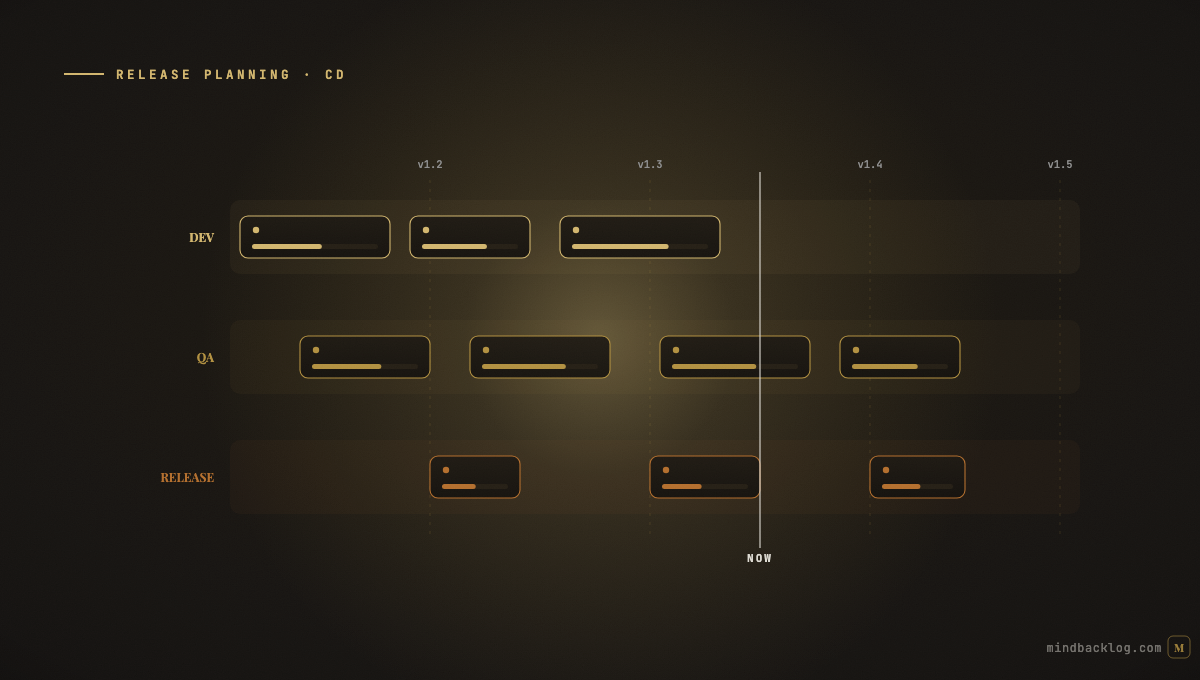
The foundational concept for PM planning in a continuous delivery environment is the distinction between deployment and release. A deployment is a technical event — code reaches production. A release is a business event — a feature becomes visible to customers with supporting communication. In continuous delivery, these two events are decoupled. A feature can be deployed behind a feature flag, tested internally, gradually rolled out to a percentage of users, and then ‘released’ — made fully available with an announcement — on a completely separate timeline from its deployment.
This decoupling gives the PM enormous flexibility. Features can be deployed and tested in production before the PM decides they are ready for customers. Multiple features can be deployed independently but released together as a coordinated theme. A feature that performs poorly in gradual rollout can be rolled back without affecting other features. The PM controls the customer experience independently of the engineering deployment schedule.
The Three-Track Model
Effective release planning in a continuous delivery environment operates on three concurrent tracks, each with its own cadence and communication strategy.
The Always Shipping track covers continuous improvements that do not require coordinated communication: bug fixes, performance improvements, minor UX enhancements, and operational maintenance. These ship as they are ready, appear in the changelog, and do not require marketing or sales enablement. The PM monitors quality but does not plan individual items.
The Feature Release track covers significant customer-facing features that benefit from coordinated communication: marketing announcements, documentation updates, sales enablement, and customer notification. These features may deploy continuously but are ‘released’ on a defined cadence — typically monthly or quarterly — as themed bundles. The theme gives the release a narrative: ‘Enterprise Search Overhaul’ is a more compelling story than ‘we shipped five features last month.’
The Platform Release track covers infrastructure and architectural changes that are invisible to customers but important for the team: database migrations, service refactoring, DevOps improvements, and scaling work. These ship continuously with no external communication but may need internal coordination to manage risk.
Feature Flags as the PM’s Control Surface
Feature flags are the mechanism that gives PMs control over release timing in a continuous delivery environment. A feature flag is a toggle that controls whether a feature is visible to users. Engineering deploys the feature behind a flag. The PM decides when to enable the flag — for internal users first, then for a percentage of customers, then for everyone.
The PM’s decisions at each stage are product decisions, not technical decisions. Internal testing validates that the feature works as specified. Gradual rollout validates that the feature performs well at scale and that customers respond positively. Full release commits to the feature as a permanent part of the product. At each stage, the PM can pause, roll back, or proceed based on data.
This staged rollout model means the PM is never committing to a release until they have production evidence that the feature is ready. The traditional risk of a big release — discovering problems after a coordinated launch — is dramatically reduced because the feature has already been validated in production before the public announcement.
Themed Releases: Bundling for Narrative Impact
Even in a continuous delivery environment, customers and stakeholders respond better to themed releases than to a constant stream of individual features. A themed release groups three to five related features under a narrative that communicates a coherent product direction: ‘This month, we focused on making enterprise account management faster and more powerful.’ The individual features are the evidence. The theme is the message.
Themed releases align naturally with roadmap planning. Each roadmap theme maps to a potential release theme. The features within the theme ship continuously but are ‘released’ (announced, documented, communicated) together. The cadence of themed releases — typically monthly or quarterly — provides the communication rhythm that stakeholders expect without constraining the engineering delivery model.
Communication Cadence
In a continuous delivery model, the PM needs three communication layers. A real-time changelog captures everything that ships, updated automatically from deployment data. A monthly or quarterly release announcement highlights the themed features with narrative framing, customer evidence, and outcome expectations. A stakeholder briefing provides context for sales, support, and leadership on how the release affects their work.
AI can generate all three communication layers from the same underlying data. The changelog is auto-generated from completed stories. The release announcement is drafted from the feature descriptions and linked signals. The stakeholder briefing is derived from the release announcement with audience-specific framing added. The PM reviews and personalizes each, but the heavy lifting of compilation and drafting is automated.
|
MindBacklog tracks features from idea through roadmap to shipped status, generating release notes and stakeholder updates from your completed work. Ship continuously, communicate coherently. Start at mindbacklog.com. |
Ready to put your product intelligence on autopilot? Start your 14-day free trial at MindBacklog.com — no credit card required.