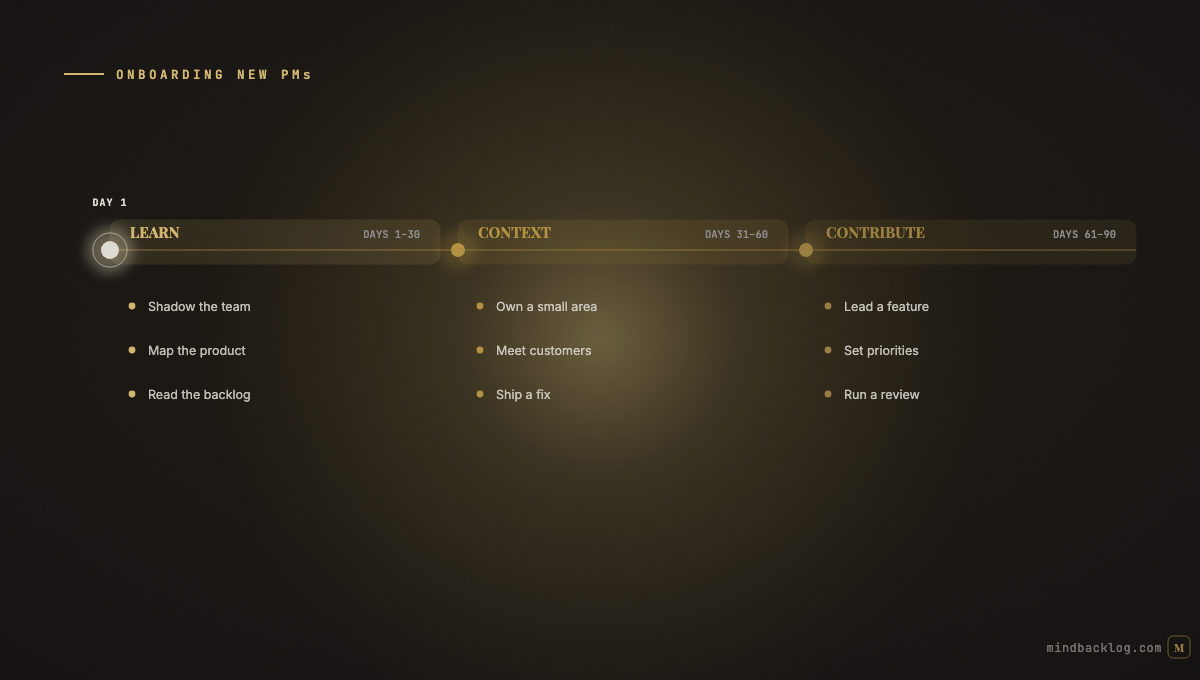
Onboarding a new product manager to an existing product is one of the most important and most underinvested activities in product organizations. The typical approach is informal: give the new PM access to the tools, point them at some documents, introduce them to key stakeholders, and hope they figure out the rest. This approach produces a PM who is nominally functional in two weeks but genuinely productive only after three to six months — because the critical context (why past decisions were made, what customers actually care about, which stakeholders need which communication style) exists in the heads of the departing PM and the tenured team members, not in any accessible system.
The cost of slow onboarding is not just the new PM’s reduced productivity. It is the opportunity cost of the decisions that are delayed, the context that is lost, and the stakeholder relationships that must be rebuilt from scratch. A PM who joins mid-quarter and needs three months to get up to speed effectively loses the entire quarter’s contribution.
The Knowledge Transfer Problem
The fundamental challenge of PM onboarding is that the most valuable product knowledge is tacit — it lives in the experienced PM’s memory, not in documents. Why was Feature X prioritized over Feature Y? What does the VP of Sales really care about? Which customer accounts are at risk? What technical constraints should inform the next roadmap? These answers are learned through months of conversations, meetings, and decision-making.
Traditional knowledge transfer methods — document handoffs, shadowing sessions, verbal briefings — capture a fraction of this tacit knowledge. The departing PM summarizes their understanding, but summaries are lossy. Important context is omitted because it seems obvious (to the person who has it) or because there is simply too much to transfer in a few handoff sessions.
How Product Context Systems Accelerate Onboarding
A product context system — like a MIND engine that maintains a persistent, evolving understanding of the product — fundamentally changes the onboarding equation. Instead of relying on the departing PM’s memory for product knowledge, the new PM has access to the synthesized Master Profile that captures what the product does, who it serves, and what makes it different. Instead of manually reviewing hundreds of feedback items, the new PM sees consolidated feature ideas with evidence trails. Instead of reconstructing the rationale behind past decisions, the new PM reads the scoring data and linked signals that informed each priority.
The AI co-pilot accelerates onboarding further. The new PM can ask questions: ‘What are the top customer complaints this quarter?’ ‘Which features have the strongest evidence but are not on the roadmap?’ ‘What is the competitive landscape for our search functionality?’ Each query returns an evidence-based answer grounded in the product’s actual data — not a stale document that may be months old.
This does not eliminate the need for human context (stakeholder relationships, organizational dynamics, cultural norms still require interpersonal learning), but it compresses the product knowledge acquisition from months to weeks.
The 30-Day Onboarding Plan
Week one focuses on product understanding. The new PM reads the Master Profile, reviews the product areas and their definitions, explores the top twenty features by signal count to understand what customers care about most, and reviews the active strategic objectives. By the end of week one, the PM understands what the product does, who uses it, and what the team is trying to achieve.
Week two focuses on customer understanding. The PM reviews the most active feedback signals, listens to three to five recorded customer calls (or conducts introductory calls), reads the most recent competitive overview, and asks the AI co-pilot specific questions about customer pain points and feedback trends. By the end of week two, the PM understands the customer landscape.
Week three focuses on backlog orientation. The PM reviews the roadmap, understands the priority order and the evidence behind it, reads the PRDs for the features currently in development, and reviews the decision log for the last quarter’s major priority decisions. By the end of week three, the PM understands the current plan and why it exists.
Week four focuses on first contributions. The PM facilitates their first prioritization discussion using the existing evidence and scoring data, writes or reviews their first feature specification using AI-generated drafts, and conducts their first roadmap communication with a stakeholder group. By the end of week four, the PM is operating — not yet at full productivity, but making real contributions informed by the product’s accumulated intelligence.
The Decision Log: Your Onboarding Secret Weapon
The single most valuable onboarding resource is a maintained decision log. New PMs constantly ask ‘why did we do it this way?’ — and if the answer is ‘I do not know, the previous PM decided that,’ the new PM must either accept the status quo blindly or re-investigate from scratch. A decision log with context, alternatives considered, and rationale provides the answer instantly.
In an AI-powered platform, the decision log is partially automated. Every feature’s activity trail captures status changes, score updates, signal linkages, and description modifications. The scoring data explains why a feature was prioritized. The linked signals explain what customers said. The new PM can trace any feature’s history without relying on institutional memory.
| MindBacklog’s MIND engine preserves product knowledge that survives PM transitions — Master Profile, evidence trails, scoring history, and an AI co-pilot that answers any question about the product. Onboard new PMs in weeks, not months. Start at mindbacklog.com. |
Ready to put your product intelligence on autopilot? Start your 14-day free trial at MindBacklog.com — no credit card required.


