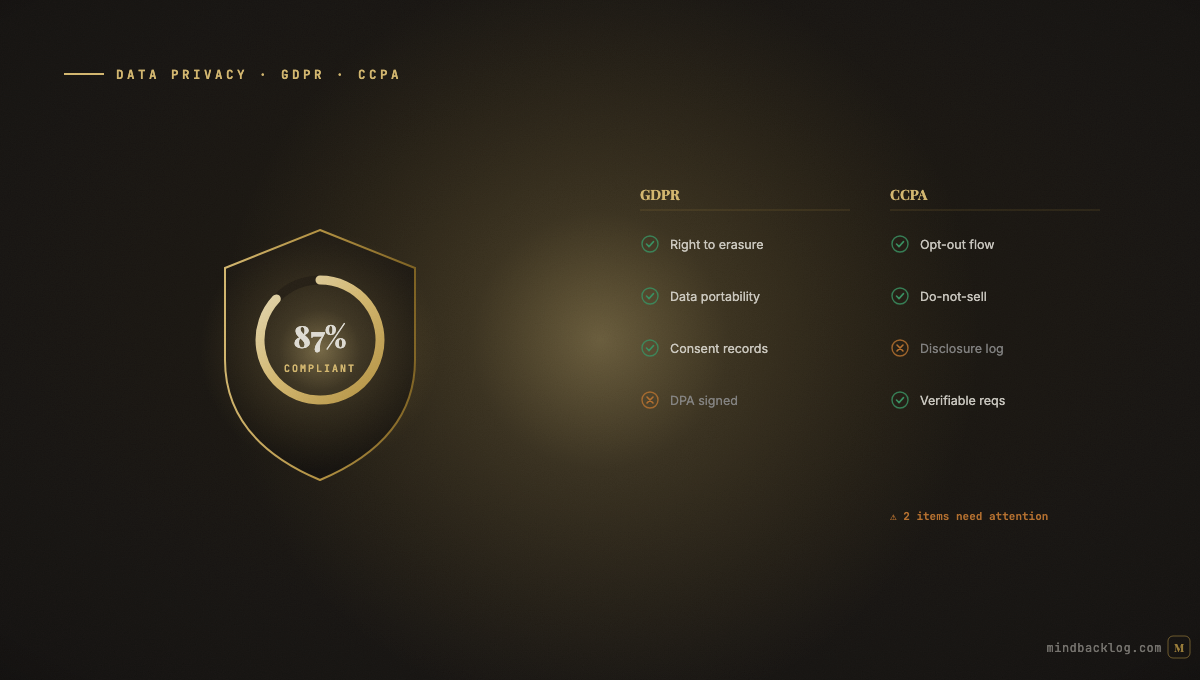
Product managers make data privacy decisions every day, often without realizing it. Every feature that collects user input, tracks behavior, stores personal information, or shares data with third parties has privacy implications. The PM who adds a feedback widget without considering that it captures user identity, or who designs an analytics dashboard that displays individual user behavior, is making privacy decisions by default — and the defaults may not comply with applicable regulations.
Data privacy is not a legal department concern that PMs can delegate. It is a product design concern that affects feature specifications, user experience, and architectural decisions. The PM does not need to be a privacy lawyer, but they need to understand the frameworks well enough to ask the right questions, include privacy requirements in specifications, and collaborate effectively with legal and security teams.
The Privacy Frameworks That Matter
GDPR (General Data Protection Regulation) applies to any product that processes data from EU residents, regardless of where the company is located. Its core principles are relevant to all privacy-conscious product design: data minimization (collect only what you need), purpose limitation (use data only for the stated purpose), storage limitation (do not keep data longer than necessary), and individual rights (users can access, correct, and delete their data).
CCPA (California Consumer Privacy Act) and its successor CPRA apply to businesses that serve California residents above certain thresholds. It emphasizes transparency (tell users what data you collect and why), opt-out rights (users can decline data selling), and data deletion rights. While narrower than GDPR, it affects most SaaS products that serve US customers.
Beyond these two headline regulations, privacy laws are proliferating globally. Brazil’s LGPD, Canada’s PIPEDA, India’s DPDP Act, and state-level US laws are creating a patchwork of requirements. The practical approach for PMs is to design for the strictest applicable standard — typically GDPR — which usually satisfies less restrictive frameworks as well.
Privacy Requirements in Feature Specifications
Every feature specification should include a privacy section that addresses eight questions. What personal data does this feature collect? What is the purpose of collecting it? What is the legal basis (consent, legitimate interest, contract performance)? How long will the data be retained? Who can access the data internally? Is the data shared with third parties? What controls does the user have over their data? What happens in a data breach affecting this data?
These questions should be answered during specification, not after development. Retrofitting privacy into a shipped feature is dramatically more expensive than building it in from the start. The PM does not need to answer all eight questions alone — legal and security teams provide guidance — but the PM needs to ensure the questions are asked and the answers are documented in the specification.
Data Minimization as a Product Principle
Data minimization — collecting only the data you need for the stated purpose — is both a regulatory requirement and a product design principle. Features that collect excessive data create storage costs, security risks, and compliance burdens without proportional product value.
When designing a feature, the PM should ask: ‘What is the minimum data needed to deliver this feature’s value?’ A feedback widget needs the feedback text and optionally the user’s identity. It does not need their browsing history, device specifications, or IP address — unless those data points serve a specific, stated purpose. Every additional data point collected must be justified by the value it provides to the user, not just to the product team.
Building Privacy Into Your Product Culture
Privacy is not a checkbox exercise performed at launch. It is a cultural practice embedded in how the team designs, builds, and operates the product. The PM sets the tone by consistently including privacy requirements in specifications, questioning data collection that lacks clear purpose, and celebrating decisions that protect user privacy even when they sacrifice analytical convenience.
Privacy reviews should be part of the feature development process — a brief checkpoint during specification review where the team verifies that privacy requirements are addressed. This is not a legal review (which happens separately for high-risk features) but a product design review that ensures privacy is considered alongside usability, performance, and functionality.
When privacy and product goals conflict — and they sometimes do — the PM must advocate for user privacy. Collecting more data might improve AI recommendations. Tracking individual behavior might produce better analytics. But if these improvements come at the cost of user trust or regulatory compliance, the PM should err on the side of privacy. Trust, once lost, is extraordinarily expensive to rebuild.
| MindBacklog practices data minimization by design — collecting only the signals you configure, processing them through a secure pipeline, and storing them with explicit purpose. Privacy-conscious product intelligence. Start at mindbacklog.com. |
Ready to put your product intelligence on autopilot? Start your 14-day free trial at MindBacklog.com — no credit card required.


