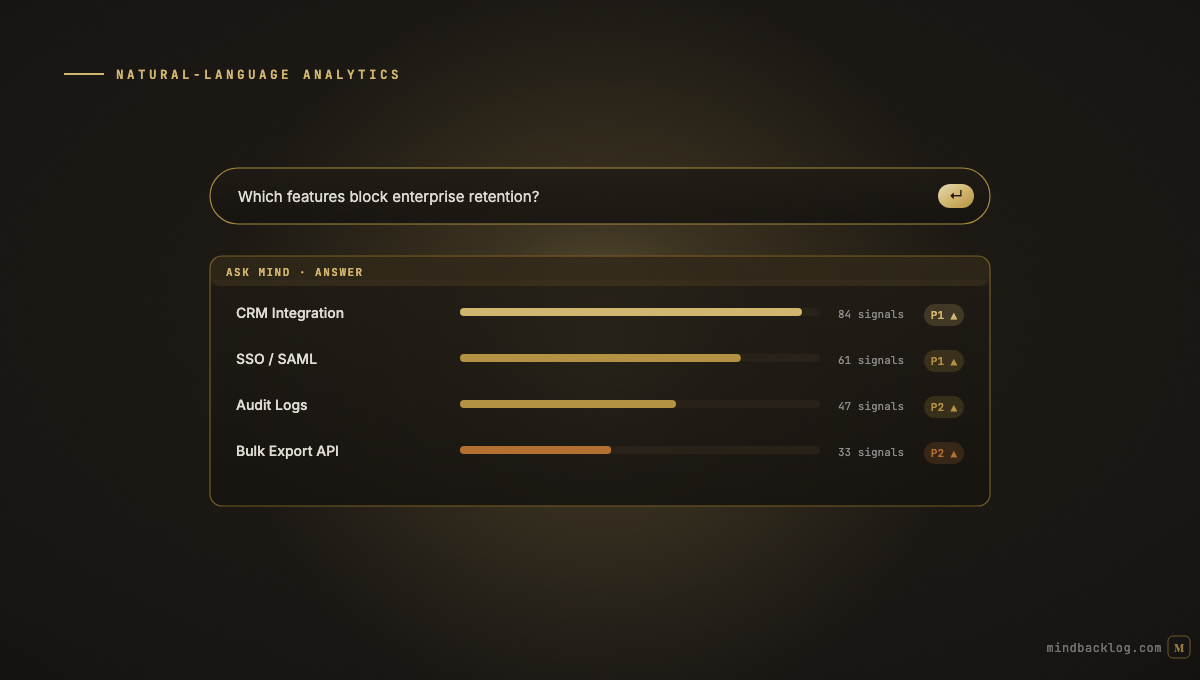
The traditional analytics workflow for product managers is a multi-step process designed for data analysts, not for PMs who need quick answers. You define a metric, configure a dashboard in your analytics tool, set the filters, wait for the data to load, interpret the visualization, and then repeat the process for your next question. Each question takes minutes to hours to answer. The result is that PMs ask fewer questions than they should — they only invest in analytics when the question is important enough to justify the workflow overhead.
Natural language product analytics inverts this equation. Instead of building dashboards to answer predetermined questions, the PM asks questions in plain language and receives instant answers. ‘Which feature area has the most unresolved feedback this month?’ ‘What are the top complaints from enterprise customers in the last 30 days?’ ‘How does our signal volume this week compare to last week?’ Each question gets an immediate response — a combination of data, visualization, and narrative summary — without any dashboard configuration.
What Conversational Analytics Enables
The most powerful effect of natural language analytics is not speed (though speed is valuable). It is the change in PM behavior. When answers are instant and free, PMs ask more questions. They explore more hypotheses. They investigate more anomalies. They follow more threads. The PM who would never have spent an hour building a dashboard to check whether bug reports increased last week will ask the question in five seconds if a conversational interface makes it possible.
This increased questioning behavior produces better product decisions because the PM operates with a richer, more current understanding of their product’s data landscape. They catch trends earlier. They spot patterns that dashboard-based analysis would have missed because no one thought to create a dashboard for that specific question.
Conversational analytics also democratizes data access within the product team. A stakeholder who does not have access to — or expertise in — the analytics tool can ask questions through the conversational interface and get the same quality of answer as the PM. This shared access to data reduces information asymmetry and improves the quality of priority discussions.
The Types of Questions PMs Should Be Asking
The most valuable conversational analytics queries fall into four categories. Trend queries identify how metrics are changing over time: ‘Is bug report volume increasing?’ ‘How has enterprise feedback sentiment changed this quarter?’ ‘Are signals about the billing module trending up or down?’ These questions catch emerging problems and validate the impact of recent changes.
Comparison queries evaluate relative performance: ‘Which product area generates the most feedback?’ ‘How does our signal volume from email compare to support tickets?’ ‘Which features have the highest signal count but the lowest roadmap priority?’ These questions reveal imbalances and misalignments that should influence prioritization.
Evidence queries support specific decisions: ‘What evidence do we have for building SSO support?’ ‘Which customers have requested advanced reporting?’ ‘What did users say about the last search improvement?’ These questions arm the PM with data for stakeholder conversations and prioritization discussions.
Strategic queries connect data to objectives: ‘Which features on the roadmap support our retention objective?’ ‘What percentage of feedback aligns with our Q2 goals?’ ‘Where are the biggest gaps between what customers want and what we are building?’ These questions ensure the product’s direction stays aligned with strategy.
Current Capabilities and Near-Term Evolution
Today’s conversational analytics capabilities in PM tools are focused on the product’s own data — feedback signals, feature scores, pipeline status, and roadmap progress. The PM can query their product intelligence system using natural language and receive structured answers grounded in real data.
The near-term evolution connects conversational analytics to external data sources — product usage analytics (Amplitude, Mixpanel), financial data (revenue by customer segment), and competitive intelligence. When the PM can ask ‘Show me the features requested by our highest-churn customer segment’ and get an answer that combines feedback data with churn analytics, the insight quality increases dramatically.
The further evolution enables multi-turn analytical conversations — the PM asks a question, gets an answer, asks a follow-up based on the result, and iterates until they reach the insight they need. This conversational flow mimics how humans naturally explore data (starting broad, narrowing based on what they find) and produces deeper insights than single-query interfaces.
|
MindBacklog’s Ask Mind is a conversational analytics co-pilot — 23 tools for querying your signals, features, roadmap, and competitive data using natural language. Ask the questions. Get the answers. Start at mindbacklog.com. |
Ready to put your product intelligence on autopilot? Start your 14-day free trial at MindBacklog.com — no credit card required.


