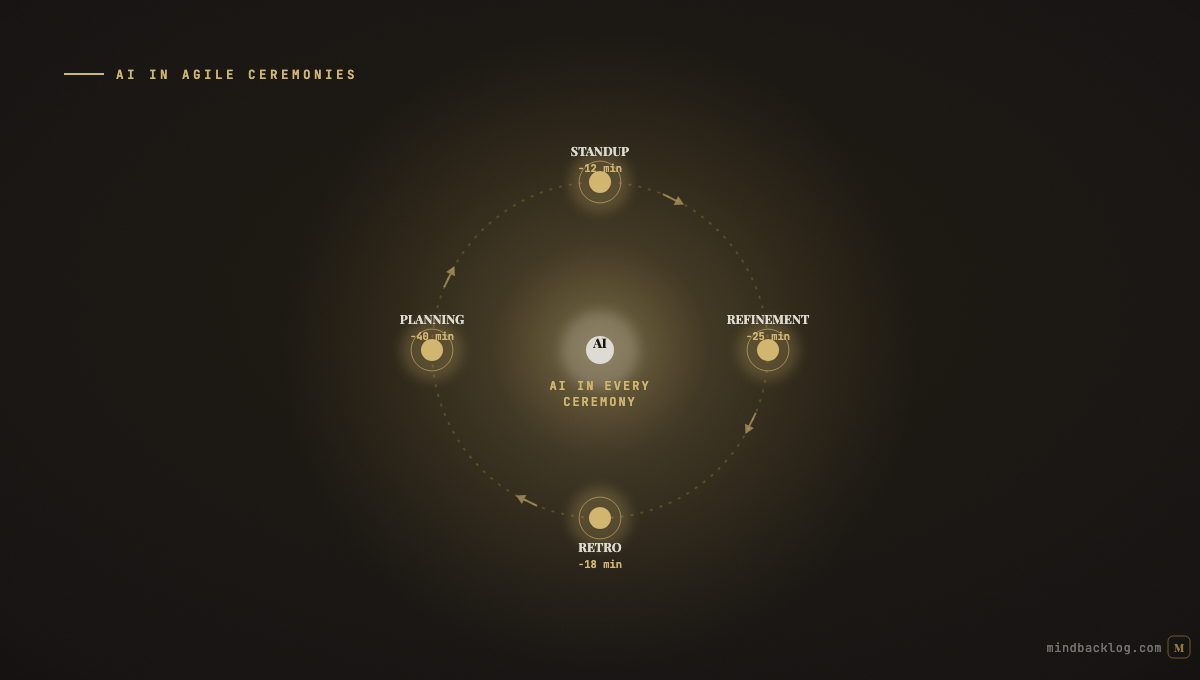
Agile ceremonies — standup, refinement, sprint planning, and retrospective — are the heartbeat of product development. When they work well, they align the team, surface risks, and drive progress. When they work poorly, they consume hours of the team’s most productive time and produce nothing actionable. AI does not replace these ceremonies. It makes each one more prepared, more focused, and more productive by automating the preparation, providing real-time context, and capturing outcomes automatically.
Standup: From Status Updates to Smart Briefings
The traditional standup is a round-robin where each team member reports what they did yesterday, what they are doing today, and what is blocking them. In practice, this format is inefficient — most updates are routine and do not require group attention. The valuable content is blockers and risks, which typically surface in the last thirty seconds of each person’s update.
AI enhances standup by generating a pre-meeting briefing that summarizes progress since the last standup (pulled from ticket status updates), flags items that have not progressed as expected, and highlights new information that arrived overnight (new customer signals, priority changes, dependency shifts). The meeting can skip the routine updates — everyone has the briefing — and focus exclusively on blockers, risks, and coordination needs.
Post-standup, AI automatically documents the blockers discussed and tracks them as action items. If the same blocker appears in consecutive standups, the system flags it as an escalation candidate.
Refinement: From Blank Pages to AI-Prepared Stories
Refinement sessions are where features are broken into user stories and the team aligns on scope and acceptance criteria. The traditional approach starts with a feature description and an empty story board — the PM and engineers collaborate in real time to decompose the feature, write stories, and define criteria. This is valuable collaborative work, but much of the session is consumed by the mechanical act of writing rather than the intellectual act of analyzing.
AI preparation transforms refinement by generating draft stories before the meeting. The team arrives at refinement with AI-generated user stories, acceptance criteria, and non-functional requirements already in place. The session’s purpose shifts from creation to review and refinement — validating the AI’s decomposition, adjusting scope, adding edge cases the AI missed, and estimating effort.
The AI also prepares an evidence summary for each feature — the customer signals that motivated it, the business value statement, and any competitive context. This summary ensures the team understands not just what to build but why, which produces better scope decisions.
Sprint Planning: From Gut Feel to Data-Informed Capacity
Sprint planning determines which stories are committed to the upcoming sprint based on team capacity and priority order. The traditional approach involves the team estimating capacity (often from memory), selecting stories until capacity is filled, and hoping the plan is realistic.
AI enhances planning by providing data-informed capacity analysis based on historical velocity. The system knows how many points the team completed in each of the last six sprints, what the trend looks like, and whether upcoming factors (holidays, team member absences) affect this sprint’s capacity. The sprint commitment is grounded in historical performance rather than optimistic estimation.
AI also recommends the priority order of stories based on the feature scores, dependency relationships, and any scheduling constraints. The PM can adjust this order based on factors the AI does not know, but the starting point is an evidence-based recommendation rather than a fresh prioritization exercise.
Retrospective: From Vague Commitments to Specific Insights
Retrospectives are meant to produce continuous improvement, but most retrospectives produce vague commitments — ‘we should estimate better,’ ‘we need to improve communication’ — that are forgotten by the next sprint. AI transforms retrospectives by providing specific, data-driven insights rather than relying on team memory and impressions.
Before the retrospective, AI analyzes the sprint data and generates findings. Instead of the team debating whether estimates were accurate, the AI reports: ‘Stories in the billing module were underestimated by an average of 35 percent. Stories involving API integrations took 2.1x longer than estimated. Overall velocity was 12 percent below the six-sprint average.’ These specific findings focus the discussion on concrete patterns rather than abstract themes.
AI also tracks improvement commitments across retrospectives. If the team committed to addressing estimation accuracy three sprints ago, the system shows whether estimation accuracy has actually improved. This accountability transforms retrospectives from feel-good exercises into genuine improvement mechanisms.
The Cultural Shift
Embedding AI into ceremonies requires a cultural adjustment. Some team members will be skeptical of AI-generated materials. Others will worry that AI analysis is evaluating their individual performance rather than improving team processes. Address these concerns directly: AI preparation is designed to make meetings more productive for everyone, not to replace team discussion or evaluate individuals.
Start with one ceremony — typically refinement, where the value of AI-prepared stories is most immediately visible — and demonstrate the time savings before expanding to other ceremonies. Success in one ceremony builds trust that facilitates adoption in the others.
|
MindBacklog’s AI generates the materials your ceremonies need — feature evidence summaries, draft user stories, priority recommendations, and sprint analytics. Prepare in minutes, not hours. Start at mindbacklog.com. |
Ready to put your product intelligence on autopilot? Start your 14-day free trial at MindBacklog.com — no credit card required.


