Product managers in 2026 have access to multiple large language models — Claude from Anthropic, GPT from OpenAI, Gemini from Google, and a growing roster of open-source alternatives. Each model has different strengths, different pricing, and different capabilities. For a PM trying to decide which model to use for their workflow, the landscape can feel overwhelming. The good news: for most PM tasks, the differences between leading models are smaller than the quality of the context you provide.
What Matters for PM Tasks
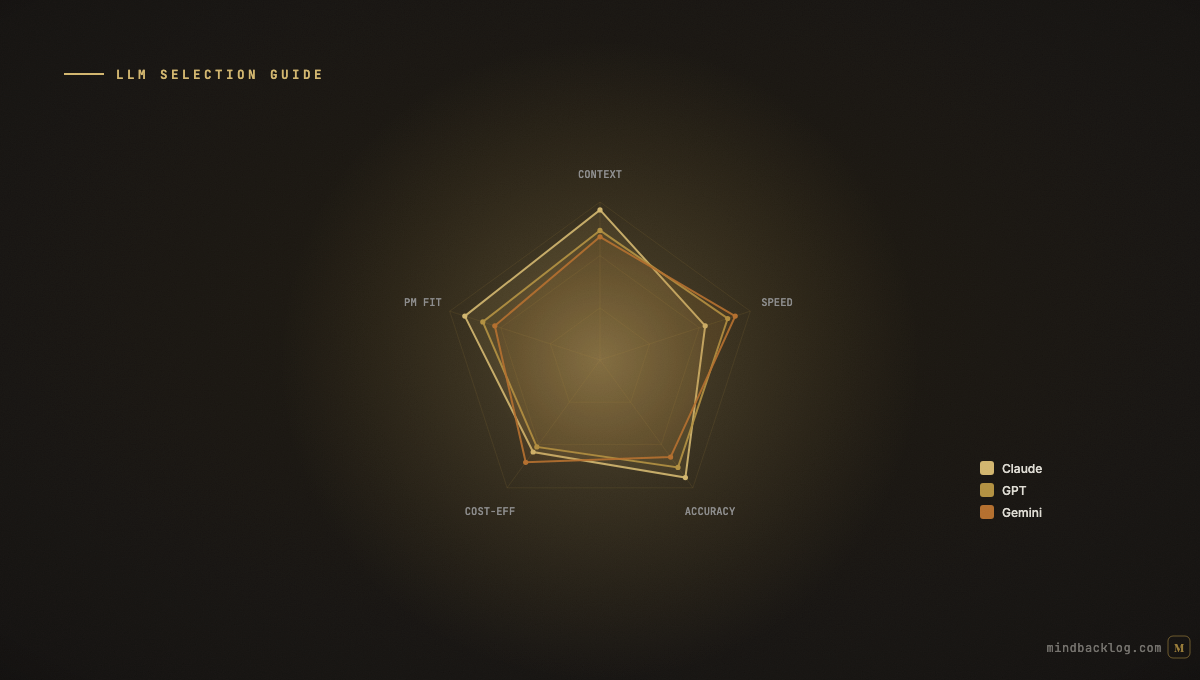
PM workflows demand specific AI capabilities that do not always align with the benchmarks used to compare models in academic or general-purpose contexts. The capabilities that matter most for PMs are: contextual reasoning (the ability to produce outputs that are specific to your product context rather than generic), structured output generation (PRDs, user stories, and scoring frameworks require consistent formatting), evidence synthesis (combining multiple data sources into coherent analyses), and instruction following (PMs need the AI to do exactly what they ask, not creatively interpret the request).
Evaluating models against these specific criteria produces different rankings than evaluating them against general benchmarks. A model that excels at creative writing may underperform at structured PRD generation. A model that produces the most engaging prose may be less reliable at following specific formatting requirements.
Claude: Analytical Depth and Safety
Claude tends to excel at analytical tasks that require careful reasoning over complex inputs. Feedback synthesis, competitive analysis, and multi-factor prioritization assessments benefit from Claude’s tendency toward thorough, nuanced analysis. Claude is also designed with strong safety and helpfulness principles, which means it is less likely to produce confidently wrong outputs — it will flag uncertainty rather than fabricate confidence.
For PMs, Claude is often the best choice for tasks requiring analytical depth: evaluating complex tradeoffs, synthesizing large bodies of feedback, and producing strategic analyses where nuance matters more than speed.
GPT: Versatility and Creative Range
GPT models offer broad versatility across task types. They handle PRD writing, story generation, stakeholder communication drafting, and creative brainstorming with consistent quality. The extensive ecosystem of plugins, integrations, and fine-tuning options makes GPT models the most accessible for teams that need flexibility.
For PMs, GPT is often the best choice for tasks requiring versatility: writing across multiple formats (PRDs, emails, presentations), generating creative alternatives for product naming or positioning, and tasks where the PM needs to iterate quickly across different output styles.
Gemini: Speed and Multimodal Capability
Gemini models are optimized for speed and multimodal processing. They handle text, images, and structured data natively, which makes them well-suited for tasks that involve processing visual inputs (screenshot analysis, design review, diagram interpretation) alongside text. Speed-optimized variants like Gemini Flash provide very low latency for high-volume processing tasks.
For PMs, Gemini is often the best choice for high-volume processing tasks: classifying hundreds of feedback signals, generating embeddings for semantic search, and processing multimodal inputs (analyzing app screenshots alongside user feedback text).
When Model Choice Does Not Matter
Here is the most important insight for PMs evaluating LLMs: for most PM tasks, the quality of the context you provide matters more than the model you choose. A mediocre model with excellent product context will outperform an excellent model with no context. A PRD generated by any leading model, given detailed feature descriptions, linked customer signals, and product knowledge, will be dramatically better than a PRD generated by the best model given only a feature title.
This is why platform-level AI — where the model is embedded in a system that maintains persistent product context — produces better outcomes than standalone model access. The platform provides the context that makes any model perform well. The model’s individual capabilities matter less when the context is doing the heavy lifting.
For PMs choosing between AI PM tools, the question should not be ‘which LLM does this tool use?’ but rather ‘how deeply does this tool integrate product context into its AI interactions?’ A tool using a slightly less capable model with deep product context integration will consistently outperform a tool using the most capable model with no context persistence.
The Multi-Model Architecture
The most sophisticated AI PM platforms do not use a single model for all tasks. They route different tasks to different models based on each model’s strengths. Classification tasks that require speed and scale go to fast, efficient models. Complex synthesis tasks that require analytical depth go to more capable models. Embedding generation goes to specialized embedding models. The platform abstracts the model selection away from the PM entirely — they interact with the system’s capabilities, not with individual models.
This multi-model architecture means the PM does not need to make a model choice at all. The platform makes the optimal choice for each task automatically, using the right model for the right job. The PM’s focus stays where it should be: on the product decisions, not the AI infrastructure.
|
MindBacklog uses a multi-model architecture — Gemini for classification and embeddings, Groq-hosted models for synthesis and chat, and specialized models for clustering. You get the right model for every task, automatically. Start at mindbacklog.com. |
Ready to put your product intelligence on autopilot? Start your 14-day free trial at MindBacklog.com — no credit card required.