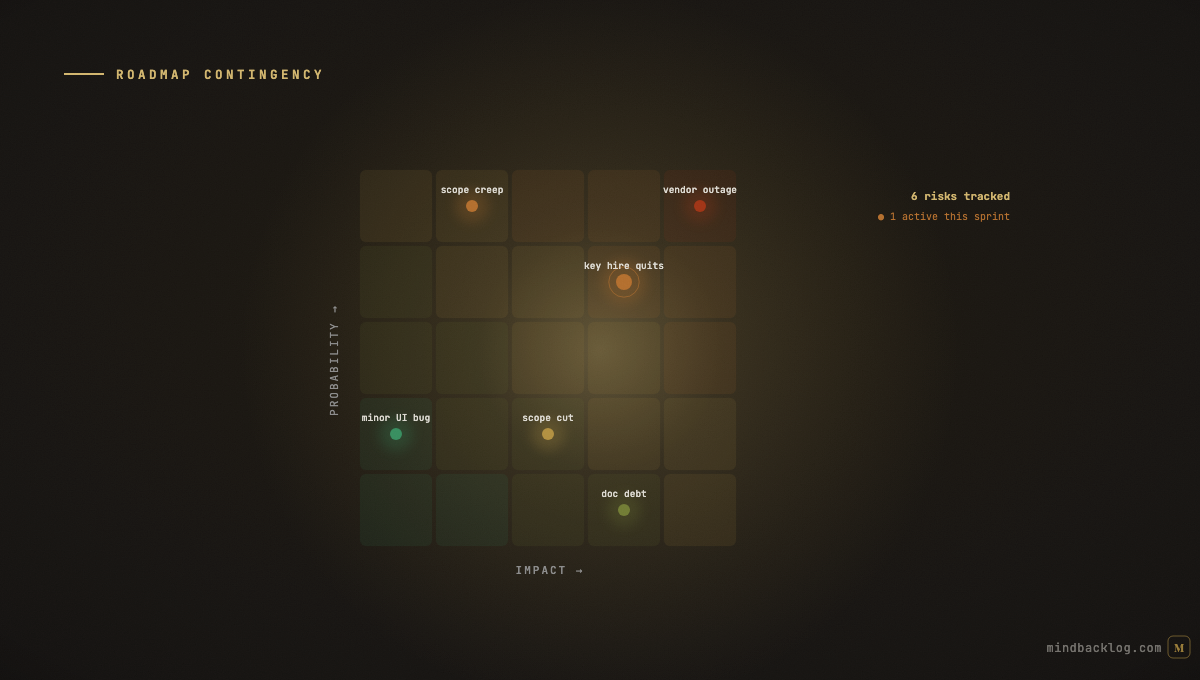
Every roadmap contains assumptions that will prove wrong. The feature estimated at four weeks will take six. The engineer assigned to the critical-path item will be out for two weeks. The partnership that was supposed to close in Q1 will slip to Q2. The competitor will ship a feature that changes your priority calculus. These are not edge cases — they are the normal operating conditions of product development. A roadmap without contingency planning is a roadmap that will fail at the first unexpected event.
Contingency planning does not mean predicting every possible disruption. It means building resilience into the roadmap so that when disruptions occur — and they will — the team has pre-planned responses rather than scrambling to improvise. The difference between a team with contingencies and a team without is not whether they encounter problems. It is how quickly and coherently they respond.
The Scope Tier Model
The most practical contingency mechanism at the feature level is scope tiering. For every feature on the roadmap, define three scope tiers before development begins. Tier 1 is the minimum viable delivery — the core functionality that delivers the primary customer value. Tier 2 adds the full intended experience — edge case handling, polish, and secondary use cases. Tier 3 adds delight and completeness — advanced options, customization, and refinements.
When time pressure arises — and it will — the team knows exactly what to cut and in what order. Tier 3 is cut first, then Tier 2, with Tier 1 protected as the non-negotiable minimum. This pre-negotiated scope hierarchy eliminates the panic-driven scope debates that happen when a deadline approaches and the team realizes they cannot deliver everything.
Scope tiers also improve communication. The PM can tell stakeholders ‘we are confident about Tier 1, optimistic about Tier 2, and aspirational about Tier 3’ — which is more honest and more useful than a binary ‘we will deliver everything’ that is likely to prove false.
Scenario Planning for the Roadmap
At the roadmap level, maintain two or three scenarios for the planning period. The baseline scenario assumes everything goes according to plan — feature estimates are accurate, team capacity is stable, and no external disruptions occur. This is the scenario you present and plan around, but you should not bet the organization on it.
The delayed scenario models the impact of the most likely disruptions: one to two features slip by two to three weeks each. Pre-identify which features in this scenario would be deferred to the next quarter to keep the overall roadmap coherent. When a delay occurs, the response is immediate — execute the pre-planned adjustment rather than convening an emergency planning session.
The reduced capacity scenario models the impact of losing 20 to 30 percent of team capacity (a key person leaves, a team is temporarily reassigned, or illness affects availability). Pre-identify the features that would be descoped or deferred to maintain the critical-path items. This scenario is more dramatic but should be planned for, because it occurs at least once per year in most organizations.
AI-Assisted Risk Identification
AI can assist with roadmap risk identification by analyzing historical patterns and current indicators. If features in a specific product area have historically exceeded estimates by 30 percent, the system flags current features in that area as estimation risks. If a feature depends on an external integration that has historically been unreliable, the system flags the dependency risk. If team velocity has been trending downward over the last three sprints, the system flags a capacity risk for the current planning period.
These AI-identified risks feed directly into contingency planning. Instead of hoping that this quarter will be different from the last five, the PM plans around the patterns that the data reveals. If the billing module always runs over estimate, the contingency plan for the billing feature assumes the overrun and prepares the scope tiers accordingly.
Communication During Disruption
The most important aspect of contingency planning is communication. When a disruption triggers a contingency response — a feature is descoped, a delivery date is adjusted, or a roadmap item is deferred — the affected stakeholders must be informed immediately, with a clear explanation of what changed, why, and what the adjusted plan looks like.
Pre-planned contingencies make this communication dramatically easier. Instead of ‘we have a problem and we are still figuring out what to do,’ the message is ‘we identified this risk in our planning, and we are executing our pre-planned adjustment. Here is the updated roadmap.’ The first message creates anxiety. The second creates confidence. The difference is preparation.
|
MindBacklog’s Timeline View with AI-predicted delivery dates and scope risk indicators gives you the early warning to trigger contingency plans before deadlines are missed. Plan for reality. Start at mindbacklog.com. |
Ready to put your product intelligence on autopilot? Start your 14-day free trial at MindBacklog.com — no credit card required.


