Writing user stories is one of the most repetitive, time-consuming tasks in a product manager’s sprint cycle. A moderately complex feature requires five to ten stories, each with acceptance criteria, non-functional requirements, and effort estimates. At thirty to sixty minutes per story, a single feature can consume an entire day of PM time — and that is before the refinement session where engineering asks the clarifying questions that reveal everything the story left out.
AI user story generators promise to compress this process from hours to minutes. But the quality gap between different approaches is enormous. A generic AI that generates stories from a title produces templates that could apply to any product. A context-aware AI that generates stories from your product knowledge, customer feedback, and feature specifications produces stories that are specific, testable, and immediately useful to your engineering team. Understanding this gap — and knowing how to get the best results — is the difference between AI that saves time and AI that creates rework.
What Makes an AI-Generated User Story Good
A good user story, whether human-written or AI-generated, meets four criteria. First, specificity: the persona is a real user type in your product, not ‘a user.’ The action references a real feature or workflow, not a generic capability. The outcome is a measurable benefit, not a vague improvement. Second, testability: every acceptance criterion can be verified by a QA engineer with a clear pass/fail determination. Third, completeness: the story covers the primary scenario, the most important error state, and any relevant non-functional requirements. Fourth, consistency: the story follows the same format, depth, and vocabulary as every other story in the backlog.
Generic AI tools fail on specificity because they lack product context. They produce ‘As a user, I want to search for items so that I can find what I need’ when what you actually need is ‘As a customer success manager managing 50+ enterprise accounts, I want to filter the account directory by tier, risk score, and last login date, so that I can identify at-risk accounts during my morning review without scrolling through the full list.’ The first is a template. The second is a specification. The difference is context.
The Three Tiers of AI Story Generation
Tier 1 is Generic AI — tools like ChatGPT or Claude used with a simple prompt like ‘write user stories for a search feature.’ The output follows the correct format but is generic enough to apply to any product. Useful as a structural template but requires extensive rewriting to be product-specific. Time savings: minimal, because the rewriting takes almost as long as writing from scratch.
Tier 2 is Prompted AI — the same tools used with a detailed prompt that includes product context, user personas, and feature specifications. The output is significantly better because the PM has manually provided the context the AI needs. The limitation is that this context must be assembled and pasted into the prompt for every generation request. Time savings: moderate, but front-loaded with prompt preparation.
Tier 3 is Context-Aware AI — purpose-built PM tools where the AI has persistent access to your product knowledge base, customer feedback signals, strategic objectives, and historical story patterns. The output is specific to your product without the PM providing context in the prompt, because the context is already in the system. The PM clicks ‘generate stories,’ reviews the output, and refines. Time savings: dramatic — story creation time drops by 60 to 70 percent.
How Context-Aware Story Generation Works
A context-aware AI story generator draws from four knowledge sources simultaneously. Product context provides the foundation: what the product does, its feature areas, its user personas, and its technical architecture. Feature context provides the specifics: the feature’s description, its scope, its purpose, and any constraints. Signal context provides the evidence: the customer feedback that motivated the feature, the specific pain points described, and the language customers used. Pattern context provides consistency: the structure and depth of stories that have previously been accepted by the engineering team.
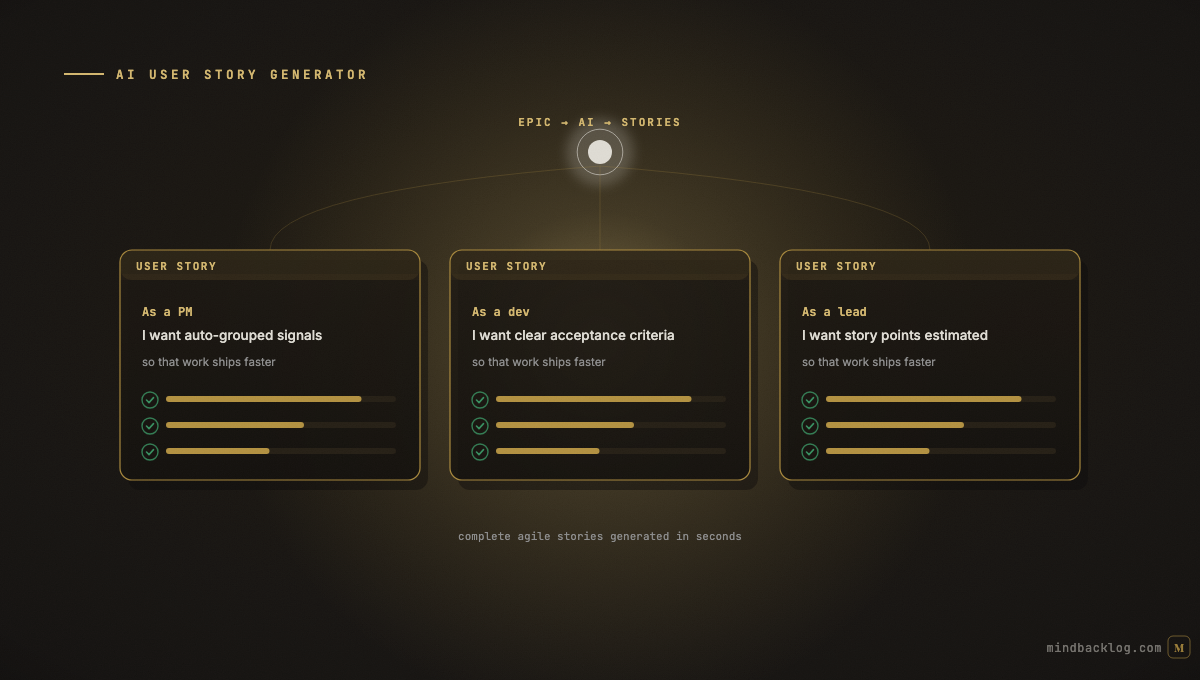
When the PM triggers story generation for a feature, the AI synthesizes all four sources into a complete set of stories. Each story has a specific persona drawn from the product’s user segments, an action that references the feature’s actual capabilities, an outcome tied to the customer need expressed in linked signals, acceptance criteria in Given/When/Then format covering the happy path and primary error states, non-functional requirements where relevant (performance thresholds, accessibility standards), and a suggested story point estimate based on the feature’s T-shirt size and the complexity of each individual story.
The generation takes seconds. The PM’s review takes ten to fifteen minutes per feature — reading each story, adjusting scope where the AI was too broad or too narrow, adding domain-specific edge cases, and validating that the acceptance criteria match the team’s testing standards. Total time per feature: fifteen to twenty minutes instead of three to five hours.
Acceptance Criteria That AI Gets Right
The most valuable component of AI-generated stories is often the acceptance criteria. PMs frequently rush through acceptance criteria due to time pressure, producing vague statements like ‘the search should return relevant results’ or ‘the page should load quickly.’ AI generates structured criteria in Given/When/Then format with specific, testable conditions.
Example: Given a customer success manager is on the account directory page and has applied the ‘Enterprise’ tier filter. When they enter a search term in the search field. Then the results display only enterprise accounts matching the search term, within 2 seconds, sorted by relevance score descending. If no results match, an empty state message displays with a suggestion to broaden the search criteria.
This level of specificity — the tier filter, the 2-second performance threshold, the empty state behavior — comes from the AI’s access to the feature description (which mentions filtering), the product context (which defines response time standards), and the linked signals (which describe the frustration with finding specific accounts). A generic AI could not produce this without extensive prompting.
Non-Functional Requirements: The Part PMs Forget
One of the highest-value contributions of AI story generation is the automatic inclusion of non-functional requirements. PMs consistently underspecify NFRs — not because they do not care about performance, security, or accessibility, but because they are focused on the functional behavior and do not have a systematic process for including NFRs in every story.
Context-aware AI includes NFRs based on the feature type and the product’s standards. A story involving data display gets a performance threshold (load time under 2 seconds for datasets up to 10,000 records). A story involving user input gets a security requirement (input sanitization for all text fields). A story involving a new interface element gets an accessibility requirement (WCAG 2.1 AA compliance, keyboard navigable). These are included automatically, ensuring that NFRs are a standard component of every story rather than an afterthought.
Story Points and Effort Estimation
AI can suggest story point estimates based on the complexity of each story, calibrated by the team’s historical velocity. A story that involves a new API endpoint, a database query change, and a UI update is more complex than a story that modifies a single UI element, and the AI can recognize this structural complexity from the acceptance criteria.
These estimates are suggestions, not prescriptions. The engineering team should always have the final say on effort — they understand implementation details that the AI cannot assess. But starting with an AI-calibrated estimate improves the efficiency of estimation sessions by providing a data-grounded starting point rather than starting from zero.
Measuring the Impact of AI Story Generation
Three metrics indicate whether AI story generation is working for your team. Time-to-sprint-ready measures how long a feature takes from approval to having sprint-ready stories. With AI generation, this should drop by 50 to 70 percent. Engineering clarification rate measures how many questions engineers ask during refinement about ambiguous or incomplete stories. With AI-generated acceptance criteria, this should decrease noticeably. Story rework rate measures how often stories need to be rewritten during development because the original specification was wrong. With context-aware generation grounded in customer signals, the story is more likely to describe what customers actually need, reducing the gap between specification and reality.
Getting Started With AI Story Generation
If you are currently writing stories manually, start by enriching your highest-priority features with context: detailed descriptions, linked customer signals, and defined product areas. Then generate stories for these enriched features and compare the AI output against your manual stories. You will likely find that the AI stories are more consistent in structure, more thorough in acceptance criteria, and more specific in persona definition — while taking a fraction of the time to produce.
The key investment is not in the AI tool itself but in the product context that powers it. A tool with rich context produces excellent stories. The same tool with minimal context produces generic templates. The quality of the output is directly proportional to the quality of the input — which is why context-aware platforms that maintain persistent product knowledge produce dramatically better results than one-shot prompting tools.
| MindBacklog generates complete user stories from your product context and customer signals — specific personas, testable acceptance criteria, NFRs, and story point suggestions. Cut story writing time by 60%. Start your free trial at mindbacklog.com. |
Ready to put your product intelligence on autopilot? Start your 14-day free trial at MindBacklog.com — no credit card required.


