On this page
- Start from the classic template, then let users fill two slots
- Collect three kinds of lines before you write
- One statement, written twice
- Three more positioning statement examples
- Name what they use today, even when it isn’t a competitor
- Test the line on the people you quoted
- Keep the statement next to the feedback behind it
- Doing this in MindBacklog
- Questions
A positioning statement says who the product is for, the problem they have, what they use today, and why yours is different. For an early product, the strongest versions fill those slots with your users’ own words instead of category language. The examples below show the same template filled both ways, for four illustrative products.
- Fill the problem and the alternative from what users said, word for word where you can.
- The alternative is usually a spreadsheet, a person or doing nothing, and only sometimes a competitor.
- Name one difference that matters to the user, not a list of features.
- Read the statement back to the people you quoted, and date every competitor claim.
Start from the classic template, then let users fill two slots
Most positioning statements follow Geoffrey Moore’s template from Crossing the Chasm. It names the target customer, their need, the product and its category, the key benefit, and the main alternative with your difference.
For [target customer]
who [need, in their words],
[product] is a [category]
that [key benefit].
Unlike [what they use now],
it [the one difference that matters to them].
Founders usually write every slot from their own head. Two of them shouldn’t come from you at all. The need and the alternative are facts about your users, and your users have already told you both. Copy them down as they said them, and resist the urge to polish.
Collect three kinds of lines before you write
Go through your interview notes, support threads and sales calls. You’re looking for three kinds of lines, in the user’s exact phrasing.
- The problem, as a moment. A specific time it hurt. “Last month I spent two evenings chasing three clients” beats “invoicing is a pain”.
- What they use now. The tool, person or workaround they rely on today, named the way they name it.
- What changed when it worked. The outcome they describe after a fix, in their units: hours, money, fewer messages.
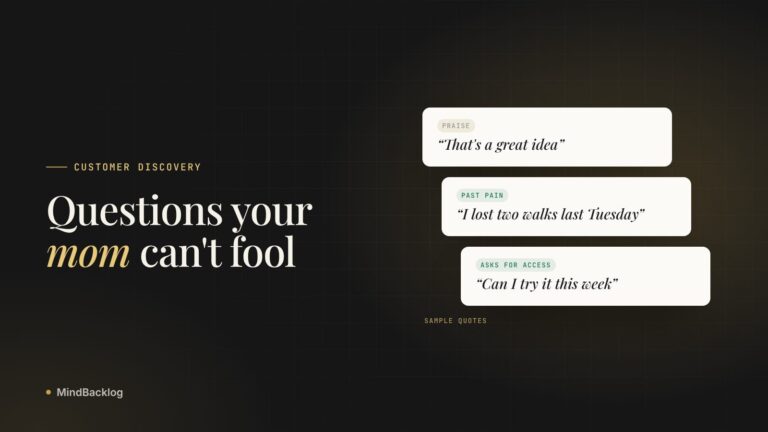
If you don’t have these lines yet, ask about the past. “Tell me about the last time you sent invoices” gets you a story with a real alternative in it. “Would you use an app that automates invoicing?” gets you a polite yes and nothing to write down.
One statement, written twice
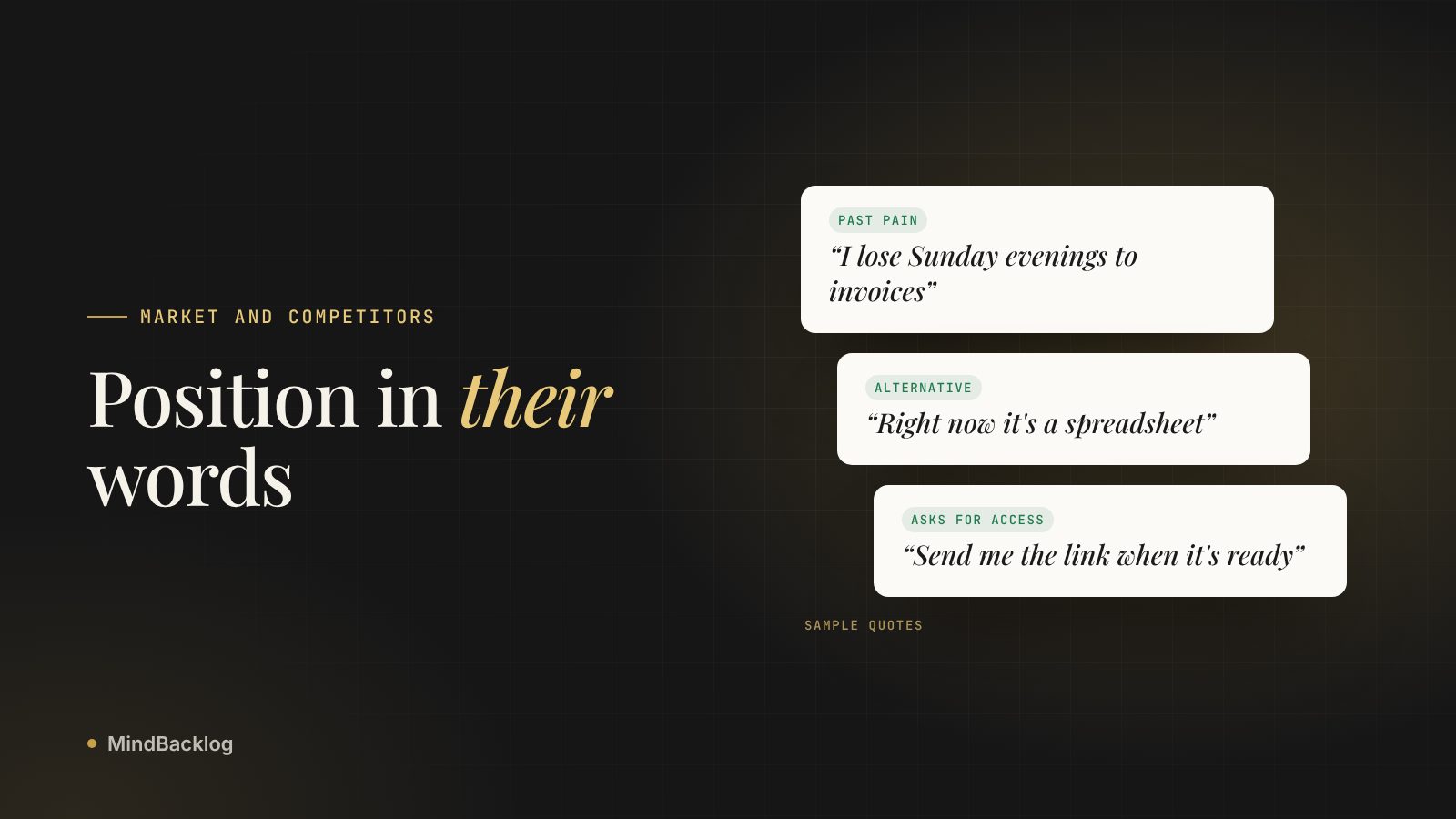
For example, a founder building an invoicing app for freelancers has a dozen interviews. Two lines keep coming back: “I lose Sunday evenings chasing clients who haven’t paid” and “right now it’s a spreadsheet and calendar reminders”. Here is the statement before and after those lines go in.
For freelancers who want a smarter way to manage their finances, [Product] is an AI-powered invoicing platform that saves time. Unlike legacy tools, it automates the busywork.
For freelancers with 5 to 20 clients who lose Sunday evenings chasing unpaid invoices, [Product] is an invoicing app that follows up for you and stops when the client pays. Unlike a spreadsheet and calendar reminders, nobody has to remember who still owes what.
Every phrase in the second version traces back to something a user said. “Smarter”, “AI-powered” and “legacy tools” came from the founder, and no freelancer would search for them. A reader who keeps a spreadsheet of late payers recognises themselves in one pass.
- AI-powered all-in-one platform
- A smarter way to manage work
- Unlike legacy tools
- For modern teams
- Sunday evenings chasing unpaid invoices
- A spreadsheet and calendar reminders
- Stops chasing once the client pays
- Freelancers with 5 to 20 clients
Three more positioning statement examples
The same method works for any early product. Each row below starts from two lines users said, one about the problem and one about what they do now. The products are illustrative.
| Product | What users said | Statement in their words |
|---|---|---|
| Booking tool for yoga studios | “Half my week goes on answering DMs about class spaces.” “We still use a paper sign-up sheet.” | For studio owners who spend half the week answering DMs about class spaces, [Product] puts live spots on one link. Unlike a paper sheet and messages, students book without asking. |
| Stock app for small bakeries | “We throw out a tray of croissants most Mondays.” “It’s a whiteboard and the head baker’s memory.” | For bakery owners who bin unsold trays every Monday, [Product] suggests tomorrow’s bake from this week’s sales. Unlike a whiteboard, it remembers last Monday too. |
| Reporting tool for small agencies | “Month end is two days of pasting screenshots into slides.” “We just use slides.” | For agency owners who lose two days a month pasting screenshots into slides, [Product] builds the client report from the live ad accounts. Unlike slides, the numbers are current when the client opens it. |
Name what they use today, even when it isn’t a competitor
The “unlike” slot trips founders up most. The tempting move is to name the best-known competitor. For an early product, the real alternative is usually a spreadsheet, a person, a habit, or doing nothing and absorbing the cost.
Naming the real alternative does two jobs. A reader knows at once whether this is for them, because they recognise their own workaround. It also tells you the bar to clear. Beating a spreadsheet means less typing. Beating an agency means lower cost or more control.
When the alternative is a competitor, check what they offer before you write the difference. Read their pricing page, help center and changelog, and note the date you read each one. A claim that was true in spring can be wrong by autumn.
Note. Write “not found in their docs, read 12 November” instead of “they don’t have it”. You only know what their public pages said on the day you read them.
Test the line on the people you quoted
A statement built from users’ words should sound familiar to those users. Read it to five of the people you quoted and watch for two reactions. If they say “that’s me” and repeat part of it back, keep it. If they correct the alternative (“I don’t use a spreadsheet, I just don’t chase them”), you’ve learned more than any wording change could teach you.
- The need uses a phrase at least one user said
- The alternative is what they do today, in their words
- One difference, and it matters to the person in the first line
- No category jargon a user wouldn’t say out loud
- A stranger could repeat it after one read
- Every claim about a competitor has a date and a source
If a developer or Lovable builds your product, the statement does a second job as the opening paragraph of every brief. The page for founders building with Lovable or a developer covers how to hand that context to whoever builds.
Keep the statement next to the feedback behind it
A positioning line goes stale when it lives in a slide deck, away from the feedback that shaped it. New users arrive with different words, and the alternative shifts as competitors move. Keeping what users said, what you decided and what you shipped in one record lets you check the line against what’s coming in now.
The invoicing founder rereads the statement each quarter. In the latest batch, six new users mention “my accountant” and none mention Sundays. The problem slot moves from chasing payment to the month-end handoff, and the alternative becomes “emailing a spreadsheet to my accountant”.
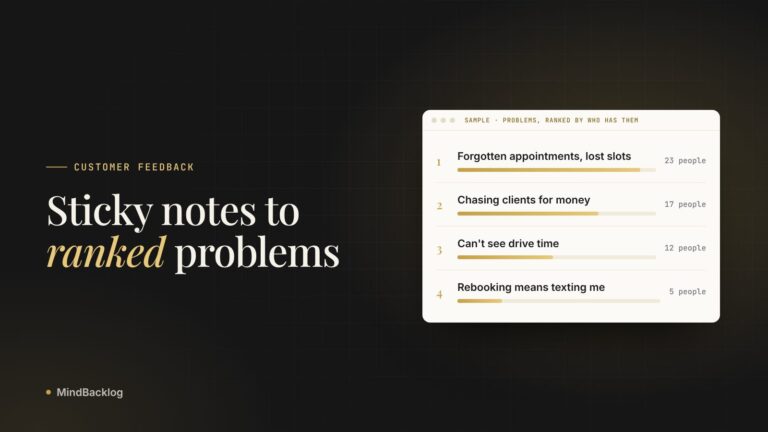
Write the next line from your users’ words. MindBacklog keeps what they said, with the problems ranked by who has them.
See how it worksDoing this in MindBacklog
MindBacklog keeps what your users said, in their words. Mind drafts your thesis, who it’s for and the beliefs to test, each with its quote, and marks every belief “no evidence yet”. Watch a competitor and Mind reads their site, pricing, help center, changelog, status page and app reviews, and every read is dated and sourced. How competitor reads work.
Questions
What are the parts of a positioning statement?
The target customer, their need, the product and its category, the key benefit, and the main alternative with your difference. The structure comes from Geoffrey Moore’s template. For an early product, the need and the alternative should come from what users said.
What is the difference between a positioning statement and a tagline?
A positioning statement is an internal sentence that sets who the product is for and what it beats. A tagline is a short public line drawn from it. Write the statement first, then pick the phrase users repeat back most often.
How often should you update a positioning statement?
Revisit it when the people writing in change, or when a competitor you name changes price or ships something relevant. For an early product, a quarterly read against recent feedback is a sensible default. Change the wording when the evidence changes, not before.