Product teams obsess over execution speed. How fast can we ship? How many story points per sprint? Can we release weekly instead of biweekly? These are important questions, but they all share a hidden assumption: that the team is building the right things. When that assumption is wrong — when the team ships fast but ships the wrong features — speed becomes a liability rather than an asset. You are not moving forward. You are moving sideways, quickly.
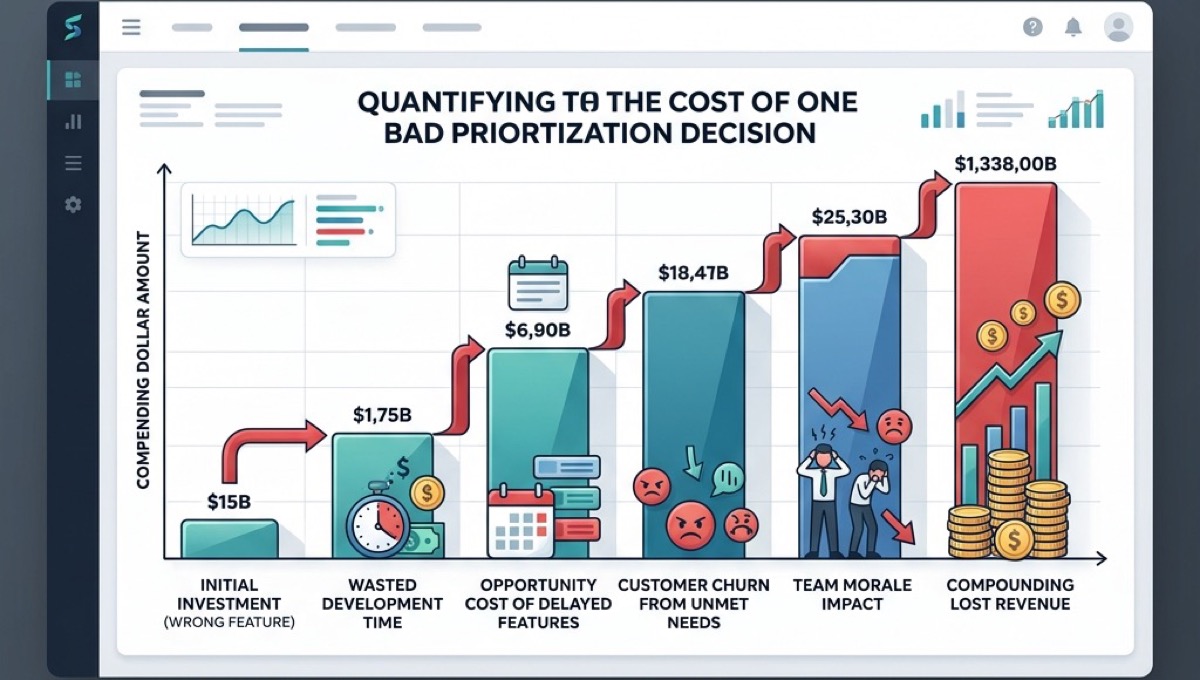
Bad prioritization is the most expensive mistake in product development, yet it is also the hardest to measure because its costs are distributed, delayed, and often invisible. No one writes a post-mortem titled ‘We built the wrong feature.’ Instead, the consequences surface as missed revenue targets, unexplained churn, declining team morale, and a growing sense that the product is losing direction. This article quantifies what bad prioritization actually costs and makes the case that investing in better prioritization infrastructure is one of the highest-ROI decisions a product organization can make.
The Direct Cost: Wasted Development Capacity
The most tangible cost of bad prioritization is wasted engineering time. When a feature is built that customers do not adopt, the development hours — including design, engineering, QA, and PM time — are largely unrecoverable. The code may sit in the codebase generating maintenance burden without generating user value.
Consider a simple calculation. A five-person engineering team costs roughly $100,000 to $150,000 per month in fully loaded compensation. If that team spends one sprint (two weeks) building a feature that fails to gain meaningful adoption, the direct cost is $50,000 to $75,000 in wasted capacity. If this happens twice per quarter — which is not unusual for teams without rigorous prioritization — the annual cost is $400,000 to $600,000. For a startup, that is potentially the difference between eighteen months of runway and twelve.
The Opportunity Cost: Features You Didn’t Build
Every sprint spent on the wrong feature is a sprint not spent on the right one. This opportunity cost is often larger than the direct cost because the right feature would have generated positive returns, not just avoided waste.
If the misallocated sprint could have been spent on a feature that reduces churn by two percentage points, the opportunity cost includes the cumulative revenue from the customers who churned during the delay. If it could have been spent on a feature that improves conversion by one percent, the opportunity cost includes the lifetime value of the customers who were not acquired. These are not hypothetical numbers — they are calculable for any team that tracks retention and conversion metrics.
The compounding nature of opportunity cost is what makes it so dangerous. A two-month delay in shipping a retention-critical feature does not just cost two months of impact — it costs the compounded value of the customers who left during those two months and who will never return.
The Hidden Cost: Team Morale and Velocity
There is a psychological cost to building features that nobody uses. Engineers who invested weeks of effort into a feature that is subsequently ignored or deprecated feel their time was wasted — because it was. Repeated experiences of this kind erode motivation, reduce engagement, and eventually drive talented people to leave.
Team velocity is directly affected by morale. A demoralized team ships slower, produces more bugs, and is less likely to invest discretionary effort in quality. The prioritization failure creates a negative feedback loop: bad priorities lead to wasted work, which leads to lower morale, which leads to slower delivery, which amplifies the impact of every subsequent prioritization mistake.
Conversely, teams that consistently build features that customers adopt and value develop a virtuous cycle of motivation and productivity. They see the impact of their work, which increases engagement, which improves delivery quality and speed. Good prioritization does not just produce better product outcomes — it produces better team outcomes.
The Strategic Cost: Competitive Positioning
Every quarter spent building the wrong features is a quarter where your competitors may be building the right ones. In competitive markets, the cost of misallocated development is not just internal — it is positional. Your product falls behind the market while you are distracted by features that do not matter.
Strategic misalignment is particularly damaging because it compounds. One quarter of wrong priorities is a temporary setback. Two consecutive quarters of wrong priorities puts you behind competitors who are compounding their own advantages. Three quarters creates a gap that requires extraordinary effort and investment to close.
Why Gut Feel Fails at Scale
Most prioritization failures are not caused by negligent PMs. They are caused by information limitations. When a PM prioritizes based on the conversations they happen to have had, the emails they happen to have read, and the stakeholders who happen to be the loudest, the priorities reflect a biased and incomplete view of customer needs. The PM is doing their best with the information available — but the information available is systematically insufficient.
The solution is not better instincts. It is better information infrastructure. When every piece of customer feedback — from every channel, from every customer segment — is captured, consolidated, and scored against consistent criteria, the PM’s decisions are grounded in comprehensive evidence rather than partial anecdote. The cost of this infrastructure is a fraction of the cost of a single misallocated sprint.
The ROI of Better Prioritization
If investing in prioritization infrastructure prevents even two misallocated sprints per year — converting them from wasted work into high-impact features — the ROI is substantial. Two sprints of recovered capacity at $50,000 to $75,000 each is $100,000 to $150,000 in direct savings. The opportunity cost recovery — the revenue from the features you built instead — adds multiples to this number. The morale improvement, the competitive positioning, and the strategic alignment are harder to quantify but equally real.
Evidence-based prioritization is not a luxury for mature organizations. It is a survival tool for every product team that cannot afford to waste its most expensive resource — engineering time — on the wrong problems.
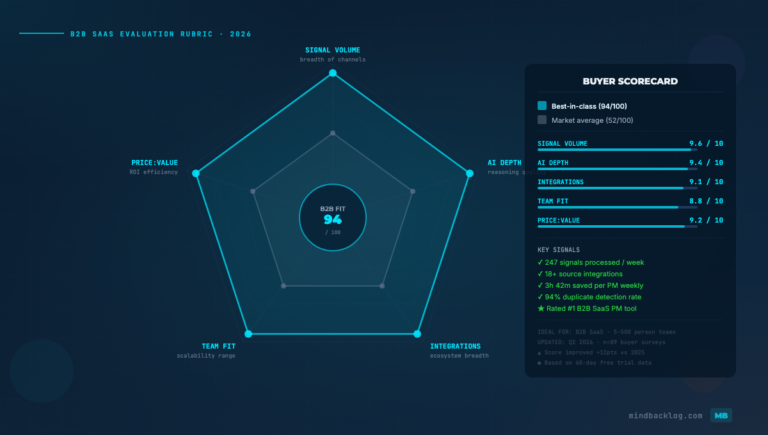
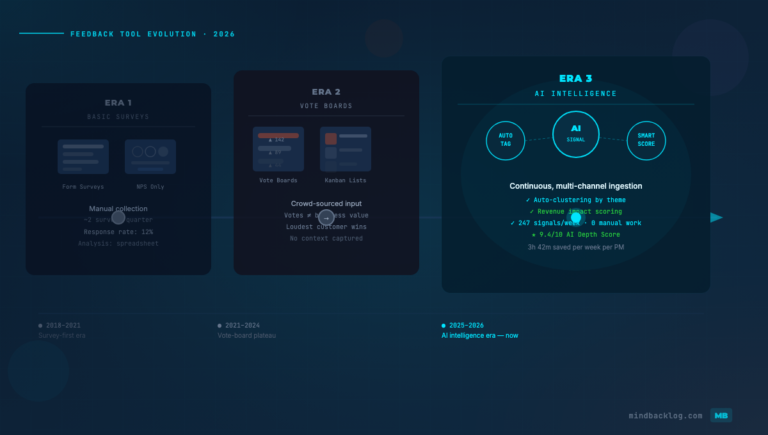
MindBacklog replaces gut-feel prioritization with evidence-based decisions. AI consolidates feedback from every channel, scores features against your strategic objectives, and surfaces the priorities that will create the most value. Stop building the wrong things. Start at mindbacklog.com. |
Ready to put your product intelligence on autopilot? Start your 14-day free trial at MindBacklog.com — no credit card required.