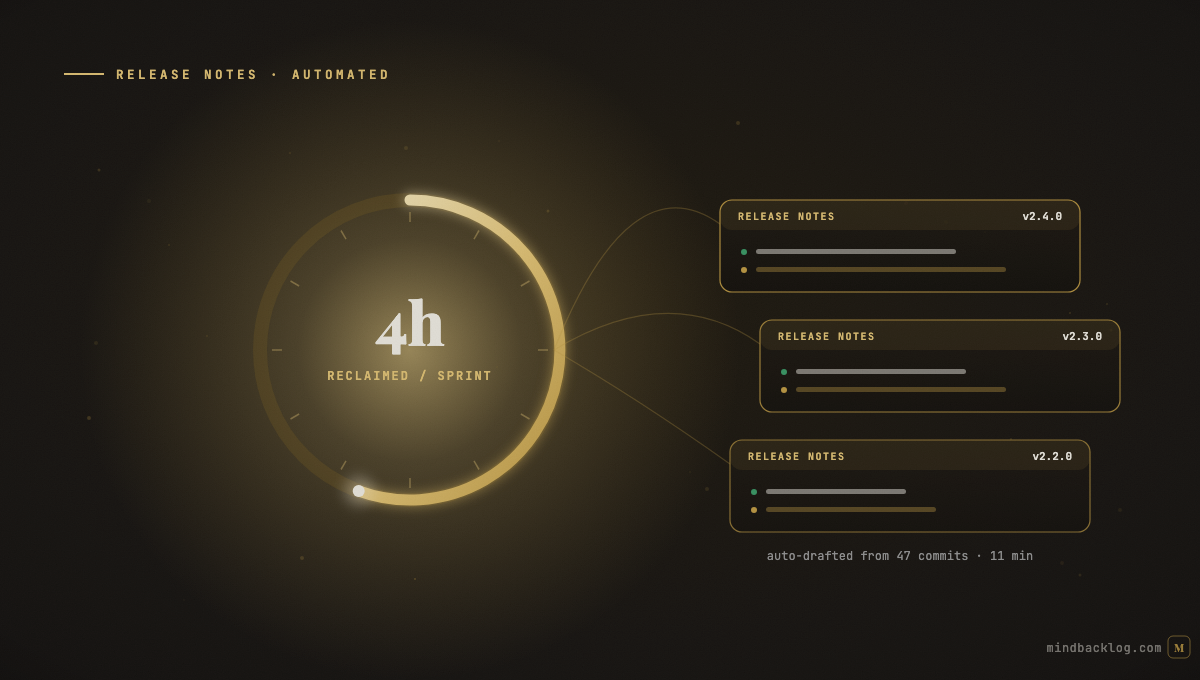
Release notes are the artifact that every product team knows they should produce and that almost no product team produces consistently or well. The reason is straightforward economics: writing good release notes takes three to five hours per sprint, the work is repetitive and uninspiring, and the consequences of skipping them are invisible in the short term. So they get deprioritized, written hastily at the last minute, or skipped entirely.
This is a shame, because release notes are one of the highest-leverage communication artifacts a product team produces. They tell customers what has changed, demonstrate that the product is actively improving, close the feedback loop for customers who requested specific features, and provide material for marketing, sales, and customer success teams. The problem is not the value of release notes — it is the cost of producing them manually.
Why Manual Release Notes Fail
Manual release note creation follows a predictable, painful workflow. The PM opens the sprint board, scrolls through completed tickets, tries to remember which changes are customer-visible versus internal, drafts a description of each change in customer-friendly language, organizes them by importance or category, and formats the result for publication. This process requires the PM to translate between engineering context (ticket titles, technical descriptions) and customer context (benefit-oriented language, clear explanations of what changed and why).
The translation step is where most of the time goes and where the quality varies most. A ticket titled ‘Refactor search indexer for pagination support’ needs to become something like ‘Search results now load faster for large datasets, with seamless pagination as you scroll.’ This translation requires understanding the customer impact of each technical change — context that the PM may have but that takes effort to reconstruct weeks after the original sprint planning discussion.
The result is that release notes are either skipped (the most common outcome), rushed (a quick list of ticket titles that means nothing to customers), or delayed (produced weeks after the release when the PM finally finds time). None of these outcomes serve the customers or the business well.
How AI Transforms Release Note Creation
AI release note generation works by pulling from three sources that already exist in your workflow: completed user stories (which describe what was built from the user’s perspective), feature descriptions (which provide the strategic context), and PRD highlights (which explain the problem being solved). Given these inputs, the AI produces release notes that are customer-facing by default — written in benefit-oriented language, organized by impact, and formatted for publication.
The AI handles the translation step that consumes most of the manual effort. It reads the technical details in the completed stories and generates customer-friendly descriptions that explain what changed, why it matters, and how it improves the user experience. The PM reviews the output, adjusts the tone and emphasis, and publishes. Total time: twenty to thirty minutes instead of three to five hours.
Two versions can be generated from the same data. A customer-facing version uses accessible language, focuses on benefits, and highlights the most impactful changes. An internal version includes technical details, links to relevant tickets, and notes on any known limitations or follow-up work. The same sprint data produces both without the PM writing either from scratch.
Release Notes as Feedback Loop Closure
Release notes serve a function beyond communication: they close the feedback loop. When a customer sees that a feature they requested has been built and shipped, their trust in the product and the product team increases. They feel heard. They are more likely to provide feedback in the future because they have evidence that their input leads to action.
AI-powered release notes can be linked directly to the customer signals that inspired each feature. If a feature was built because forty-seven customers requested it across three channels, the release note can reference this: ‘Based on feedback from dozens of customers, we have redesigned the user search to include advanced filtering by account tier, last login date, and subscription status.’ This explicit connection between customer input and product output is one of the most powerful trust-building mechanisms available to a product team.
If your platform supports submitter tracking, the release can automatically trigger notifications to the specific customers who provided feedback related to the shipped feature. This individual-level loop closure — ‘you asked for this, we built it, here it is’ — is extraordinarily effective for retention and engagement.
Templates for Different Audiences
Different audiences need different release note formats. Customers want a brief, benefit-focused summary with clear explanations of what changed. A weekly email digest or in-app changelog works well. Internal teams want more detail: the customer-facing changes plus technical notes, known issues, and follow-up items. A Slack post or internal wiki page serves this purpose. Stakeholders want a summary focused on strategic progress: which objectives advanced, which customer themes were addressed, and what the next sprint targets.
AI can generate all three versions from the same underlying sprint data. The PM configures the template once, and each sprint’s notes are generated in the appropriate format for each audience. The total effort across all three versions is still less than the time previously spent on the customer-facing version alone.
The Compound Value of Consistent Release Notes
The teams that produce release notes consistently — every sprint, without fail — build a compound asset that becomes increasingly valuable over time. A twelve-month archive of release notes becomes a searchable changelog that customers can reference. It becomes sales collateral that demonstrates product momentum. It becomes a competitive differentiator that shows a pace of improvement competitors cannot match.
AI makes this consistency achievable. When release note creation takes twenty minutes instead of four hours, it never gets skipped. When the quality is consistent because the AI applies the same structure and tone every time, the changelog maintains professional standards even when the PM is having a busy sprint. Consistency is the goal, and automation is what makes it realistic.
|
MindBacklog’s Ask Mind generates release notes, stakeholder updates, and sprint summaries from your completed features and stories. AI drafts, you review. 20 minutes instead of 4 hours. Start at mindbacklog.com. |
Ready to put your product intelligence on autopilot? Start your 14-day free trial at MindBacklog.com — no credit card required.


