Prioritization workshops are one of the most consequential meetings on the product team’s calendar. The decisions made in a two-hour session — which features advance, which are deferred, which are killed — shape the product’s trajectory for the next quarter. And yet, most prioritization workshops are poorly structured. They devolve into opinion debates, are dominated by the loudest voices, run over time without reaching decisions, and produce outcomes that participants do not fully buy into.
A well-structured prioritization workshop produces clear, defensible decisions with broad stakeholder alignment — in two hours or less. The key is preparation (most of the analytical work should be done before the meeting), structure (every minute of the workshop should serve a specific purpose), and follow-through (decisions must be documented and communicated immediately). AI pre-analysis transforms the preparation phase from hours of PM work into minutes of automated analysis.
Phase 1: AI Pre-Analysis (Before the Workshop)
The single biggest improvement you can make to a prioritization workshop is completing the analytical work before the meeting. When participants arrive at a workshop with no shared data, the first hour is consumed by presenting information, asking clarifying questions, and debating the accuracy of estimates. This is preparation work masquerading as a meeting.
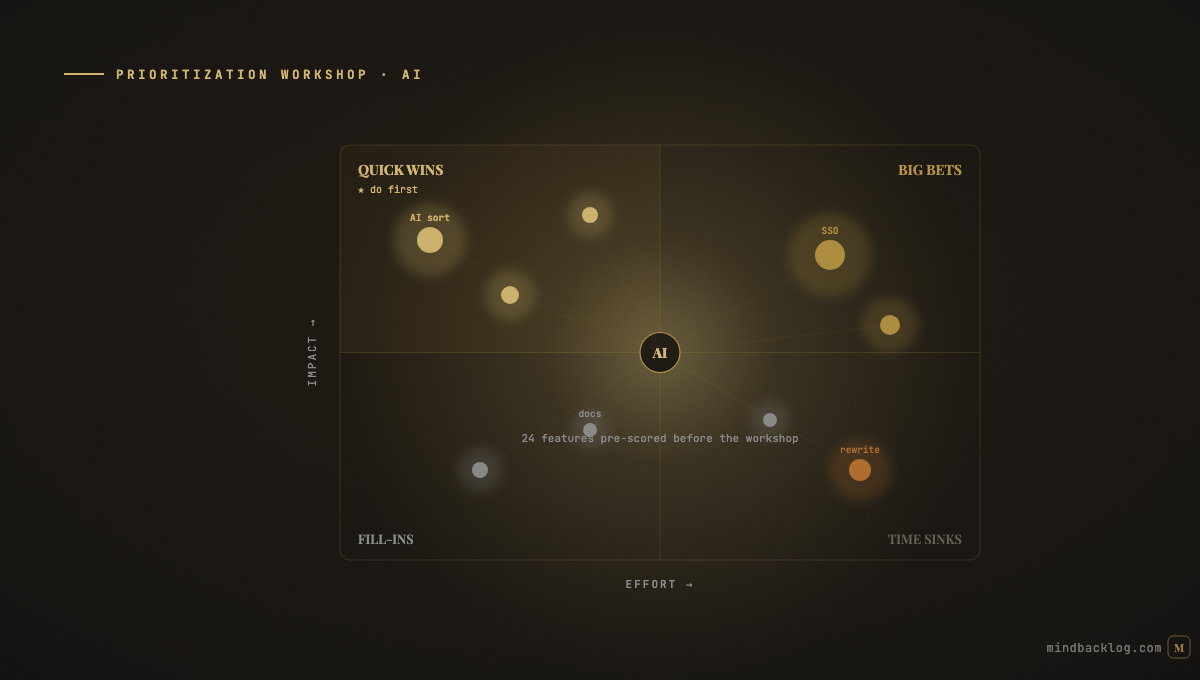
AI pre-analysis generates the analytical foundation that the workshop operates on. Before the meeting, the system produces a scored ranking of all candidate features using the agreed-upon framework (RICE, WSJF, or AI Priority Score). Each feature’s score includes the evidence behind it: signal count, source channels, sentiment breakdown, strategic alignment, and effort estimate. The system also flags the features with the highest uncertainty — where the evidence is thin or the scoring inputs are ambiguous — as recommended discussion topics.
Share this pre-analysis with all participants 48 hours before the workshop. Participants arrive having already reviewed the data, formed preliminary views, and identified the specific items they want to discuss. The workshop can skip the information-sharing phase entirely and begin with discussion and decision.
Phase 2: The Workshop (2 Hours Maximum)
A well-structured workshop follows a three-part agenda. Part one (20 minutes): review and ratify the top tier. Start with the features that scored highest and have the strongest evidence. For most workshops, the top five to seven features are non-controversial — the data clearly supports their priority. Walk through them briefly, confirm alignment, and move them to ‘approved’ status. This creates early momentum and reduces the number of items requiring deeper discussion.
Part two (60-75 minutes): discuss and decide the contested middle. This is where the workshop adds the most value. The middle tier — features with moderate scores, uncertain evidence, or competing stakeholder perspectives — requires human judgment that the data alone cannot provide. Allocate discussion time proportionally: spend more time on features where the group disagrees or where the evidence is ambiguous, and less on features where the data is clear but the score is borderline.
Use structured discussion techniques to keep the conversation productive. For each contested feature, start with the data (what the AI scoring shows and why), then invite dissenting perspectives (does anyone see something the data misses?), then force a decision (approve, defer, or kill, with a brief rationale documented). If a decision cannot be reached in five minutes, park it and move on — a ten-minute debate about one feature costs the entire workshop’s remaining agenda.
Part three (15-20 minutes): address the bottom tier and wrap up. Quickly review the lowest-scoring features. Most can be moved to ‘deferred’ or ‘killed’ without discussion. For any that a participant wants to advocate for, allow a two-minute pitch and a quick group decision. Close the workshop by summarizing the decisions: which features are approved for the roadmap, which are deferred to next quarter, and which are killed.
Phase 3: Post-Workshop (Same Day)
The value of a prioritization workshop evaporates if the decisions are not documented and communicated immediately. Within the same business day, publish a summary that includes the approved features with their priority order, the deferred features with the reasoning for deferral, and any killed features with the reasoning for removal. Update the roadmap to reflect the approved features. Notify stakeholders who were not in the workshop.
AI can generate the post-workshop documentation from notes taken during the meeting. The summary, the stakeholder notification, and the roadmap updates can be drafted by AI and reviewed by the PM — turning a sixty-minute post-meeting documentation task into a fifteen-minute review.
Making the Workshop a Recurring Practice
Prioritization workshops should occur at a regular cadence — monthly or quarterly depending on your release cycle. The regular cadence ensures that priorities are revisited as new evidence arrives, that deferred features are reconsidered when their evidence strengthens, and that the team maintains shared context on the product’s direction.
Each subsequent workshop gets easier because the AI pre-analysis is cumulative. Features that were deferred last month have accumulated new evidence (or not), and their updated scores reflect the change. The PM does not need to manually re-evaluate every feature before each workshop — the system maintains current scores based on continuously flowing data.
|
MindBacklog provides the AI pre-analysis that makes prioritization workshops productive — scored features, evidence summaries, and flagged discussion points, all generated automatically. Run better workshops in half the time. Start at mindbacklog.com. |
Ready to put your product intelligence on autopilot? Start your 14-day free trial at MindBacklog.com — no credit card required.


