Product Operations — or ProductOps — emerged as a discipline because the operational overhead of product management outgrew what individual PMs could handle. As product teams scaled, the administrative burden of managing feedback pipelines, maintaining prioritization frameworks, generating reports, and coordinating cross-functional workflows created a need for dedicated operational support. Large product organizations responded by creating ProductOps roles to handle this burden.
AI is changing the ProductOps equation. Many of the operational tasks that drove the creation of dedicated ProductOps roles — feedback routing, pipeline maintenance, report generation, score calculation, and template management — can now be automated by AI-native platforms. This does not eliminate the need for product operations thinking. It does eliminate the need for dedicated human headcount to perform operational tasks that AI can handle more consistently, more quickly, and at lower cost.
What ProductOps Does Today
ProductOps responsibilities typically fall into four categories. Process management: defining and maintaining the workflows that product teams follow — from feedback intake through prioritization, specification, development, and launch. Tooling: selecting, configuring, and maintaining the product management tool stack, including integrations between tools. Reporting: generating the dashboards, summaries, and metrics that product leadership uses to assess performance and make resource allocation decisions. Knowledge management: maintaining product documentation, decision records, and institutional knowledge.
In practice, the majority of ProductOps time goes to the most operational of these categories: maintaining feedback pipelines, updating dashboards, generating periodic reports, and ensuring data consistency across tools. These are important activities — the product organization cannot function without them — but they are repetitive, data-intensive, and pattern-based. In other words, they are exactly the type of work that AI excels at.
The AI Automation Layer
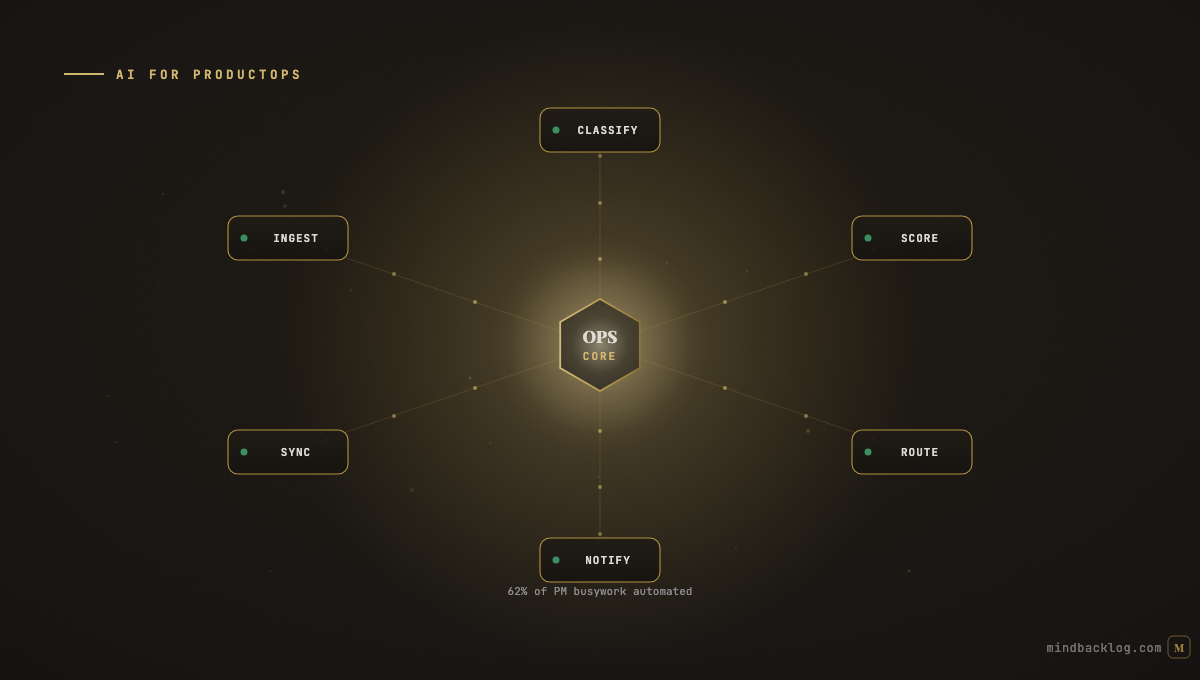
AI-native product management platforms automate the operational backbone of ProductOps across all four categories.
For process management, the AI pipeline replaces manual feedback routing. Instead of a ProductOps person reading each piece of feedback and deciding where it goes, the AI classifies, routes, and links feedback automatically. Pipeline health monitoring — detecting stuck items, stale signals, or failed channel connections — is automated through scheduled system checks.
For tooling, the integrated platform reduces the number of tools that need configuration and maintenance. Instead of managing integrations between five or six point solutions, the PM and ProductOps manage a single platform with built-in feedback collection, classification, scoring, roadmapping, and specification capabilities. The integration burden drops from five-to-six connections to one or two (typically the development platform sync).
For reporting, AI generates the most common ProductOps outputs automatically. Daily briefs synthesize overnight activity. Pipeline dashboards show real-time status across all stages. Priority reports with evidence summaries are available on demand. AI-generated stakeholder updates can be produced in minutes rather than hours.
For knowledge management, the MIND engine serves as an always-current product knowledge base that is automatically enriched by every piece of feedback, every context source, and every feature decision. This persistent intelligence replaces the manually maintained product wikis and decision logs that typically fall out of date within weeks.
What Humans Still Do Best in ProductOps
AI automation does not eliminate all ProductOps activities. Several functions remain human-led. Strategic process design — deciding what the product workflow should be, how priorities should be evaluated, and what cadences the team follows — requires organizational understanding and judgment that AI cannot provide. Cross-functional facilitation — coordinating between product, engineering, sales, and support teams, resolving process conflicts, and ensuring alignment — is an interpersonal activity that benefits from empathy and political awareness.
The shift is from ProductOps as an operational execution role (routing feedback, updating dashboards, compiling reports) to ProductOps as a strategic design role (optimizing workflows, improving decision quality, and ensuring the AI automation is configured correctly). The human focuses on designing the system. The AI executes it.
The Small Team Advantage
For small product teams (one to five PMs), the AI automation of ProductOps is particularly transformative. These teams cannot justify a dedicated ProductOps hire — the budget and headcount are not available. Without AI, the operational overhead falls entirely on the PMs themselves, consuming 30 to 40 percent of their capacity.
AI-native platforms give small teams the operational infrastructure of a large product organization without the headcount. Feedback is processed automatically. Scores are maintained automatically. Reports are generated automatically. The PM’s 30 to 40 percent operational tax drops to 5 to 10 percent of review and oversight. The recovered time goes to strategic work — which is precisely where small teams need to invest to compete with larger, better-resourced competitors.
|
MindBacklog automates the ProductOps operating system — feedback routing, priority scoring, reporting, and knowledge management — in one AI-native platform. The operational infrastructure of a 50-person product org, available to a team of one. Start at mindbacklog.com. |
Ready to put your product intelligence on autopilot? Start your 14-day free trial at MindBacklog.com — no credit card required.