Product teams spend a staggering proportion of their time in meetings. Standups, refinements, sprint planning, retrospectives, customer calls, stakeholder reviews, design critiques — a PM can easily spend twenty to twenty-five hours per week in meetings, with much of the remaining time spent preparing for or following up on those meetings. The meeting problem is not new, but the tools for extracting value from meetings are evolving rapidly.
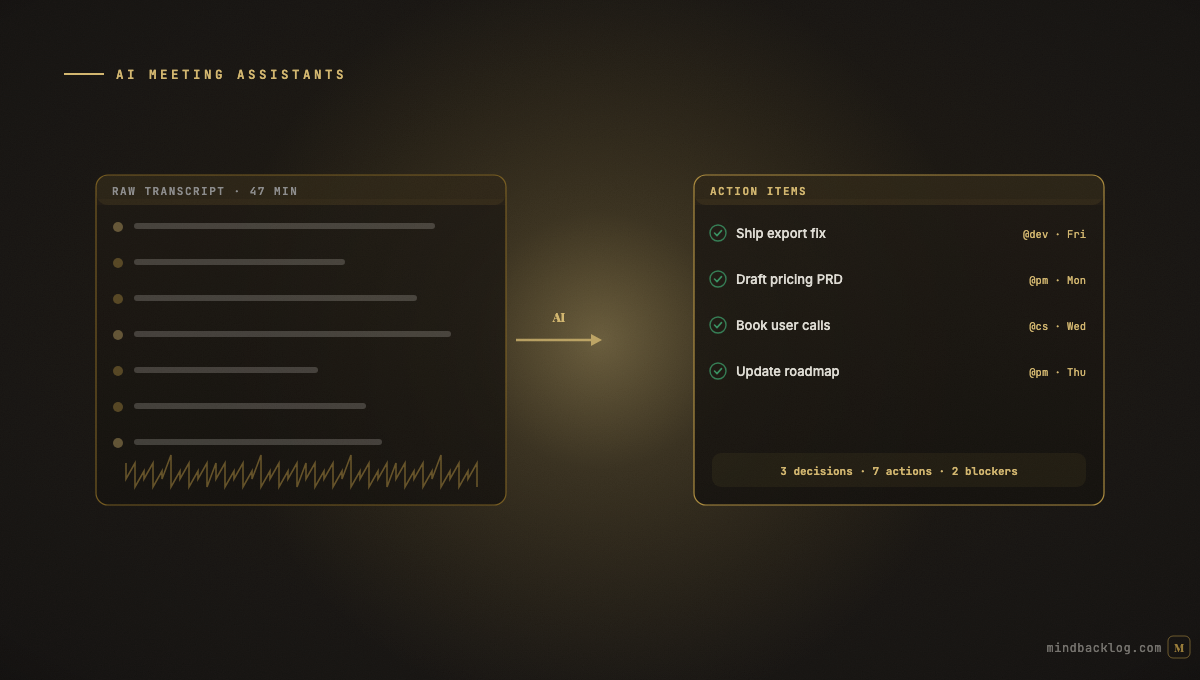
The first generation of AI meeting tools focused on transcription — converting speech to text so you have a searchable record. This was useful but limited. Having a transcript does not mean the insights within it have been captured, categorized, or acted upon. A forty-five-minute refinement call might contain three feature requests, two scope clarifications, and one architectural risk — buried in forty minutes of discussion about unrelated topics. The transcript preserves everything but highlights nothing.
The current generation goes further. AI meeting assistants now extract structured data from conversations: action items with assigned owners, feature requests that should be added to the backlog, decisions that need documentation, and risk flags that warrant follow-up. The meeting becomes an input source for the product management workflow, not just a communication event.
What AI Can Extract From Product Meetings
The most valuable extractions for product teams fall into four categories. Action items are explicit commitments made during the meeting — ‘I will review the search performance data by Thursday’ or ‘engineering will spike the database migration this sprint.’ AI identifies these from conversational cues (commitment language, future tense, named individuals) and structures them with owners and deadlines.
Feature requests surface when customers or team members describe unmet needs during meetings. In customer calls, these are direct requests. In internal meetings, they often appear as pain points or workarounds described by support, sales, or engineering. AI can detect these and route them to the feedback pipeline for processing alongside signals from other channels.
Decisions are statements of resolved intent — ‘we are going to ship search improvements before the reporting overhaul’ or ‘we decided to defer SSO to Q3.’ Capturing decisions is critical for accountability and reduces the ‘I thought we decided the opposite’ syndrome that plagues teams with poor meeting documentation.
Risk flags are expressions of concern or uncertainty — ‘I am worried the timeline is too aggressive’ or ‘the integration might be more complex than we estimated.’ These signals are easy to miss in the flow of conversation but important for proactive risk management.
Ceremony-Specific Applications
Each agile ceremony has specific extraction needs. In standups, the primary extraction is blockers — items that are preventing progress and need resolution. AI can detect blocker language (‘I am stuck on,’ ‘waiting for,’ ‘cannot proceed until’) and compile a blocker list with owners for immediate follow-up.
In refinement sessions, the primary extractions are scope clarifications and acceptance criteria discussed verbally. Engineering teams often describe requirements more clearly in conversation than in written comments. AI captures these verbal specifications and structures them as additions to the relevant user stories.
In retrospectives, the primary extraction is improvement commitments — specific changes the team agrees to make. AI can track these commitments across sprints, flagging when the same improvement was committed to in previous retrospectives but not implemented.
In customer calls, the primary extraction is product feedback — feature requests, pain points, competitive comparisons, and satisfaction indicators. These are routed to the feedback pipeline and processed through the same AI classification and matching system as every other signal source.
The Integration Gap
The current limitation of AI meeting tools is integration. Most operate as standalone systems that produce transcripts and extraction summaries but do not connect directly to your product management platform, your development tracker, or your feedback pipeline. The extracted feature request sits in the meeting tool’s interface rather than flowing into your feature scoring system. The action item lives in the meeting summary rather than your task management tool.
This integration gap is closing as meeting tools develop APIs and product management platforms add meeting ingestion capabilities. The future state — already partially realized — is one where meeting content flows through the same intelligence pipeline as email, support tickets, and web form submissions. A feature request made during a customer call receives the same AI classification, deduplication, and scoring as a feature request submitted through a web form.
The Future: AI Participants in Product Meetings
The next frontier is AI that does not just passively listen to meetings but actively participates. Imagine a refinement session where the PM asks ‘what do customers say about this feature area?’ and an AI participant answers with a summary of relevant signals from the feedback pipeline. Or a planning meeting where the AI flags that a feature being discussed conflicts with a dependency identified in the roadmap. Or a standup where the AI reports that three new high-urgency signals arrived overnight for a feature currently in development.
This active participation model is technically feasible today — the AI has the knowledge (through the product context system) and the communication capability (through natural language generation). The challenges are more practical: audio integration quality, latency for real-time responses, and the cultural adjustment of having an AI participant in team meetings. Early implementations are emerging, and within the next year or two, AI meeting participants will move from novelty to standard practice for product teams.
|
MindBacklog’s Ask Mind already answers the questions you would ask in a meeting — customer evidence, signal trends, feature status, and competitive context. The intelligence is ready. Ask Mind is your always-available co-pilot. Start at mindbacklog.com. |
Ready to put your product intelligence on autopilot? Start your 14-day free trial at MindBacklog.com — no credit card required.