Most roadmap presentations fail not because the roadmap is wrong but because the communication is wrong. The PM walks into the meeting with a feature list organized by quarter, reads through each item with a brief justification, and hopes the audience is convinced. The audience — whether executives, sales, or customers — nods politely and walks away with roughly the same understanding they had before the meeting. The roadmap was presented. It was not communicated.
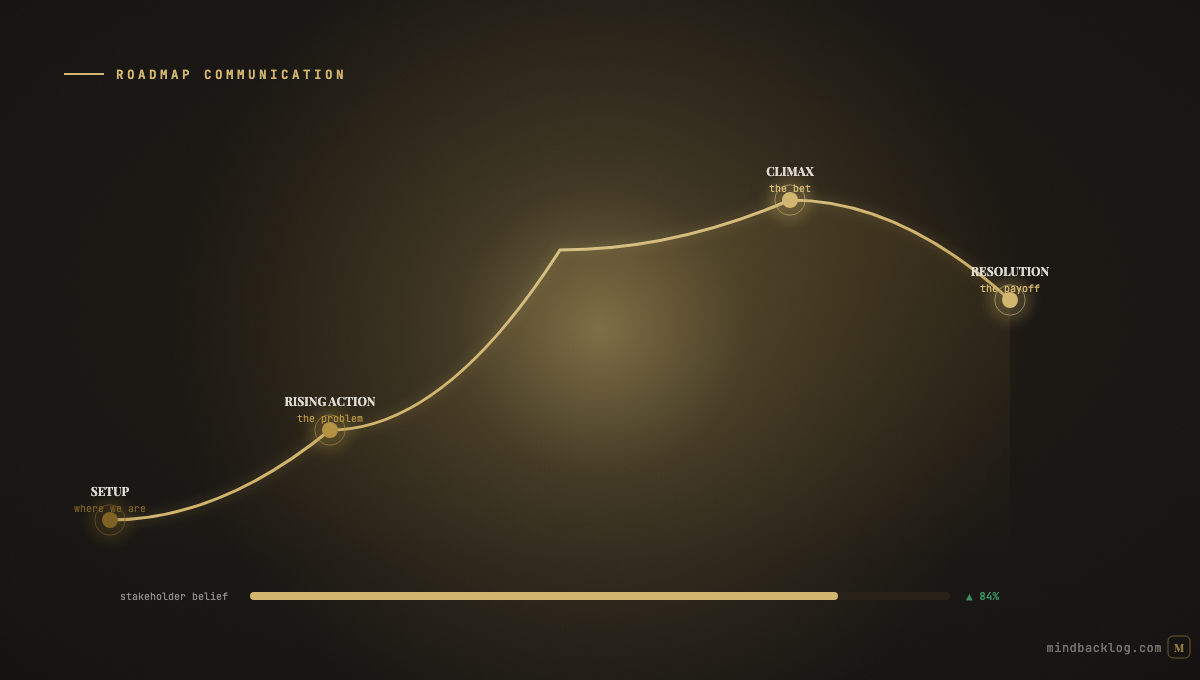
Effective roadmap communication is storytelling, not data presentation. It answers the questions stakeholders actually care about — Why these priorities? What outcomes will they produce? How do we know this is the right direction? — in a narrative structure that builds from context to conviction. The features are not the story. They are the evidence that supports the story.
The Three-Act Roadmap Narrative
Every compelling roadmap presentation follows a three-act structure. Act One establishes context: where the product stands today, what customers are experiencing, and what the data shows. This act grounds the audience in shared reality. It is not a history lesson — it is a concise summary of the current state that creates urgency for action. Use customer evidence here: signal volumes, sentiment trends, competitive movements. When the audience sees the data, they arrive at the same conclusions the PM has already reached.
Act Two presents the strategic direction: the themes, outcomes, and priorities that define the next planning period. This is not a feature list — it is a set of outcome commitments organized by strategic theme. Instead of ‘we are building advanced search filtering,’ the narrative is ‘we are addressing the #1 enterprise pain point — account lookup speed — which will reduce the most common support ticket category by an estimated 40 percent and protect $2.1M in at-risk ARR.’ The features exist within this narrative, but the narrative leads.
Act Three addresses execution: the timeline, the team allocation, the key milestones, and the risks. This is where the Gantt chart or timeline view belongs — as supporting evidence for the narrative, not as the narrative itself. Present the timeline as the plan for delivering the outcomes described in Act Two, with explicit acknowledgment of the assumptions and risks that could affect delivery.
Audience-Specific Framing
The same roadmap must be communicated differently to different audiences because each audience cares about different aspects of the plan.
Executives care about strategic alignment and business impact. Frame the roadmap in terms of objectives, revenue impact, competitive positioning, and risk mitigation. Use the language of the business: ARR protection, market share, strategic differentiation. Avoid feature-level detail unless an executive specifically asks for it.
Sales teams care about deal impact and competitive positioning. Frame the roadmap in terms of which features remove deal blockers, close competitive gaps, and enable upselling. Provide timelines that sales can use in customer conversations — but frame them as quarters, not specific dates, to avoid over-commitment.
Engineering teams care about technical coherence and feasibility. Frame the roadmap in terms of dependency chains, architectural implications, and capacity allocation. Engineering appreciates the ‘why’ context (customer evidence and strategic rationale) but evaluates the roadmap through the lens of ‘can we actually build this in this sequence?’
Customers care about outcomes and timelines. Frame the roadmap in terms of what will change for them and roughly when. Avoid internal jargon, technical details, and caveats that create confusion rather than clarity. A customer-facing roadmap should be shorter and simpler than any internal version.
Evidence as the Trust Builder
The single most effective trust-building technique in roadmap communication is evidence citation. When every priority on the roadmap can be traced to specific customer signals — ‘this theme is driven by 147 signals from 89 accounts across four channels’ — the audience trusts that the priorities reflect real customer needs rather than the PM’s personal preferences or the loudest stakeholder’s opinion.
AI-powered platforms make this evidence citation effortless. Every feature on the roadmap has linked signals with counts, sentiment breakdowns, and source channel distribution. The PM can click into any feature during the presentation and show the complete evidence trail. This transforms roadmap reviews from ‘trust me’ presentations into ‘look at the data’ discussions.
Trust compounds over time. When the PM presents an evidence-backed roadmap in Q1, delivers on the commitments in Q2, and shows the results in Q3 — ‘we said this feature would reduce support tickets by 40 percent, and it actually reduced them by 37 percent’ — the next roadmap presentation starts from a position of earned credibility. Each cycle of promise, delivery, and measurement strengthens the trust that makes future roadmap communication more effective.
Common Communication Mistakes
The most common roadmap communication mistakes are predictable and avoidable. Presenting a feature list without a narrative makes the roadmap feel like a to-do list rather than a strategic plan. Over-committing on dates creates expectations that become trust liabilities when deadlines slip. Under-explaining the ‘why’ leaves the audience wondering whether the priorities are well-reasoned or arbitrary. Failing to acknowledge what is NOT on the roadmap creates an impression that every request has been silently declined rather than deliberately deferred.
Address the last point explicitly. Reserve five minutes of every roadmap presentation for ‘what we considered but deferred and why.’ This transparency shows that deferred features were evaluated, not ignored, and gives stakeholders confidence that their input was heard even when it did not result in immediate roadmap placement.
The Living Roadmap Conversation
Roadmap communication should not be a quarterly event. The most effective product teams maintain a continuously accessible roadmap that stakeholders can consult at any time — with evidence visible, statuses current, and the strategic narrative intact. Quarterly presentations become check-ins rather than reveals, because stakeholders have been watching the roadmap evolve in real time.
AI-powered dashboards enable this continuous visibility. The daily brief surfaces roadmap-relevant changes. The timeline view shows current status with predictive overlays. Ask Mind answers stakeholder questions about the roadmap using current data. The roadmap is not a document the PM presents. It is a shared workspace that everyone can access and that the PM narrates periodically.
|
MindBacklog’s evidence-linked roadmap turns every stakeholder meeting into a data conversation. Timeline views, signal counts per feature, and AI-generated summaries — all shareable. Tell a story backed by evidence. Start at mindbacklog.com. |
Ready to put your product intelligence on autopilot? Start your 14-day free trial at MindBacklog.com — no credit card required.