Most product management training focuses on user-facing features: screens, workflows, and interactions that a human navigates through a graphical interface. But an increasing proportion of product value is delivered through APIs — programmatic interfaces that other software consumes. When your product has an API, your users include developers, your interface is an endpoint, and your user experience is measured in response times, error handling, and documentation quality rather than visual design and interaction flow.
PMs who transition from UI-focused products to API-inclusive products often struggle because the mental model is different. You cannot wireframe an API. You cannot A/B test an endpoint. The feedback comes in the form of integration failures and developer frustration rather than user interviews and NPS scores. This article covers the PM skills that are specific to API product management and that are rarely taught in traditional PM training.
The API PM’s Mental Model
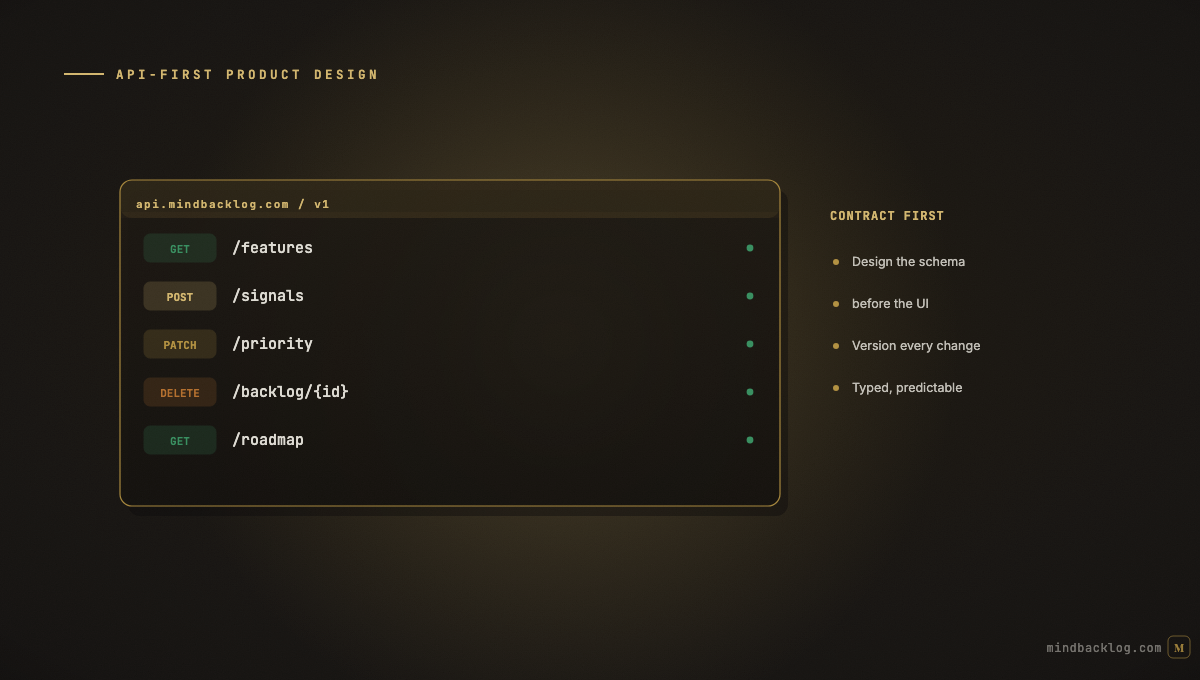
An API-first PM thinks in contracts rather than interfaces. The API contract defines what data goes in, what data comes out, what happens when something goes wrong, and what guarantees the system provides about performance and availability. This contract is the product — not the code behind it, not the infrastructure supporting it, but the promise the API makes to every developer who integrates with it.
Breaking an API contract — changing the response format, removing a field, altering error codes — is the API equivalent of redesigning a core UI workflow without warning. It breaks every integration that depends on the current behavior. This means API product decisions carry higher backward-compatibility stakes than UI decisions, and the PM must think carefully about versioning, deprecation, and migration paths before shipping changes.
Defining API Requirements
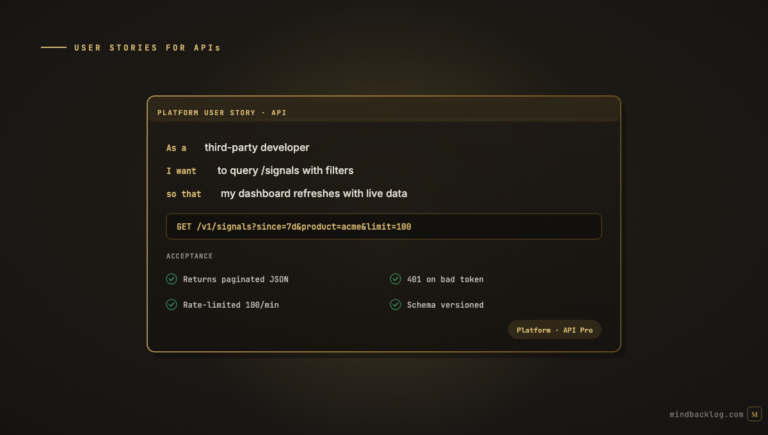
API requirements differ from UI requirements in several important ways. Instead of user stories that describe screen interactions, API requirements describe data operations: ‘The endpoint must accept a filter parameter for account tier and return paginated results sorted by last activity date.’ Instead of acceptance criteria based on visual states, API criteria define response formats, status codes, and error messages.
The PM does not need to write the technical specification — that is the engineering team’s domain. But the PM does need to define the product-level requirements: what operations the API supports, what data is exposed, what permissions are required, what rate limits apply, and what the developer experience should feel like. These are product decisions that affect how developers perceive and adopt the API.
Documentation is a first-class product requirement for APIs. Unlike UI features where users can discover functionality by exploring the interface, API features are invisible without documentation. An undocumented endpoint does not exist from the developer’s perspective. The PM should treat documentation as part of the feature definition, not as a follow-up task.
Prioritizing for Platform Extensibility
API products create value not just through direct usage but through the ecosystem they enable. Every integration a developer builds on your API extends your product’s reach and creates switching costs that benefit retention. Prioritization for API products should explicitly consider ecosystem value — the number and quality of integrations an API capability enables — alongside direct user value.
A feature that enables ten partner integrations may be more valuable than a feature that improves the direct user experience marginally, because the partner integrations collectively reach users and use cases that the core product cannot serve alone. This ecosystem thinking is a distinct prioritization dimension that does not appear in traditional PM frameworks.
Developer Experience as User Experience
For API products, the developer is the user. Developer experience — how easy it is to understand the API, write a successful first integration, debug when things go wrong, and maintain the integration over time — is the equivalent of UI usability for screen-based products.
The PM should evaluate developer experience with the same rigor applied to UI usability. Time to first successful API call (analogous to time to first value in a SaaS product) is a critical metric. Error message clarity (analogous to in-app help text) affects developer satisfaction. SDK quality and code examples (analogous to onboarding tutorials) determine adoption speed.
Collecting developer feedback follows the same principles as customer feedback collection — monitor developer forums, track support ticket themes, and analyze API usage patterns to identify friction points. AI-powered feedback analysis works equally well for developer-facing signals as for end-user signals.
| MindBacklog captures feedback from developers and end users alike — classifying API-related signals, tracking developer pain points, and scoring platform features alongside UI features. One pipeline for all your users. Start at mindbacklog.com. |
Ready to put your product intelligence on autopilot? Start your 14-day free trial at MindBacklog.com — no credit card required.